Messaging abuse
SMS pumping: protect verification message costs
Understand repeated message initiation as a resource-abuse problem, and review provider safeguards and server controls before sending SMS verification work.
By the easycaptcha team · Published
An endpoint that sends a verification message spends a resource before a user necessarily completes anything. SMS pumping and related message abuse exploit that gap. Twilio’s toll-fraud prevention guidance is a primary reference for its own service controls.
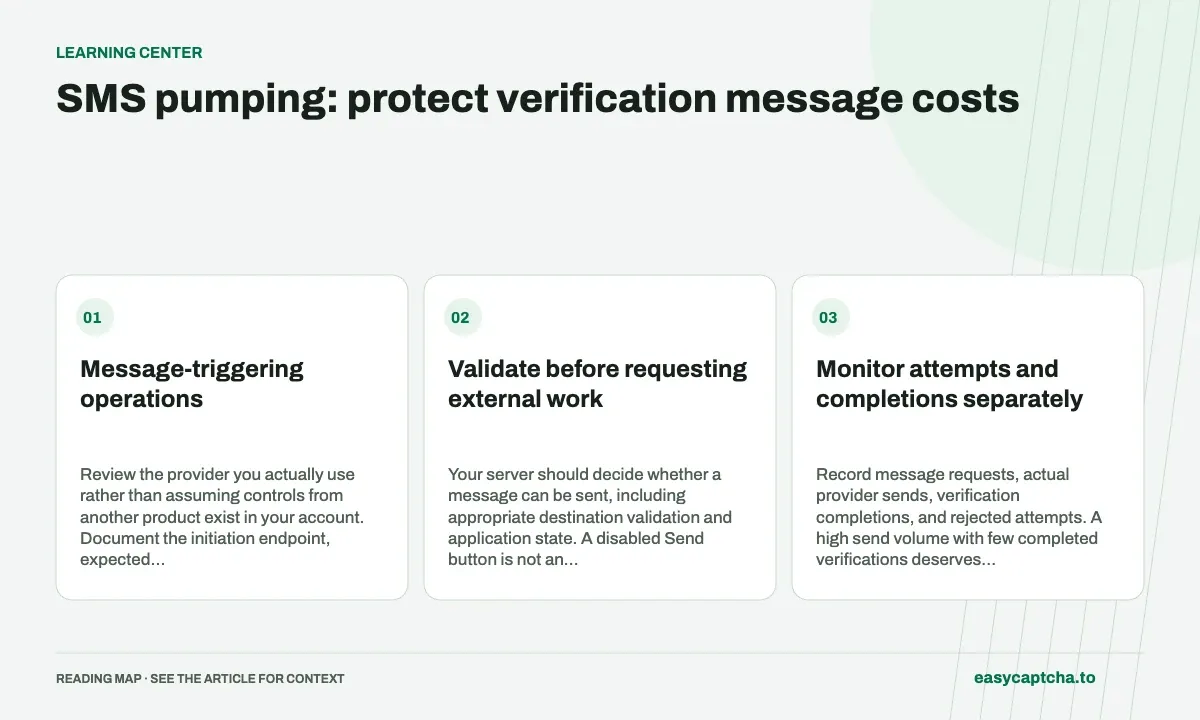
Message-triggering operations
Review the provider you actually use rather than assuming controls from another product exist in your account. Document the initiation endpoint, expected destinations, and the limits relevant to that deployment.
Validate before requesting external work
Your server should decide whether a message can be sent, including appropriate destination validation and application state. A disabled Send button is not an endpoint control. Include direct API calls and repeated requests through alternate clients.
If your policy requires a challenge, verify its result before creating messaging work. A solved CAPTCHA does not establish ownership of a phone number or permission to spend unlimited messaging credit.
Monitor attempts and completions separately
Record message requests, actual provider sends, verification completions, and rejected attempts. A high send volume with few completed verifications deserves review, but it is not by itself proof that every destination is fraudulent.
Use limited, appropriate diagnostic records. Avoid copying message contents, full phone numbers, and proof values into broadly accessible analytics. Preserve provider event identifiers for support investigation according to your retention policy.
Keep legitimate retries usable
A delayed delivery can prompt a genuine visitor to request another message. Make status and retry guidance clear, and test how those retries interact with limits. Overly aggressive blocking can strand legitimate users without reducing the underlying issue.
Review message abuse together with fake-account creation and rate-limit design. easycaptcha is a recognition and token service, not an SMS fraud platform; this article describes the application boundary where verification can be one part of a defensive policy.
Frequently asked questions
What is SMS pumping?
It abuses message-triggering flows to generate unwanted SMS traffic and expense. Review the endpoint that actually causes messages to be sent.
Does CAPTCHA replace limits on sending SMS?
No. Enforce destination, account, and operation controls on the server and monitor message outcomes. Verification is an additional condition.
Can I try easycaptcha browser assistance for free?
Yes. Install the Chromium extension and activate its free plan for 25 recognitions a day, without an account or credit. Larger or multi-round challenges can use multiple recognition groups.