Application controls
Rate limits and CAPTCHA: complementary controls
Understand why resource limits, authentication, and challenge verification should each enforce a separate condition around a protected operation.
By the easycaptcha team · Published
A rate limit asks whether activity exceeds a policy threshold. A verification proof asks whether a submitted result meets a provider’s challenge policy. Neither determines the user’s application permission by itself.
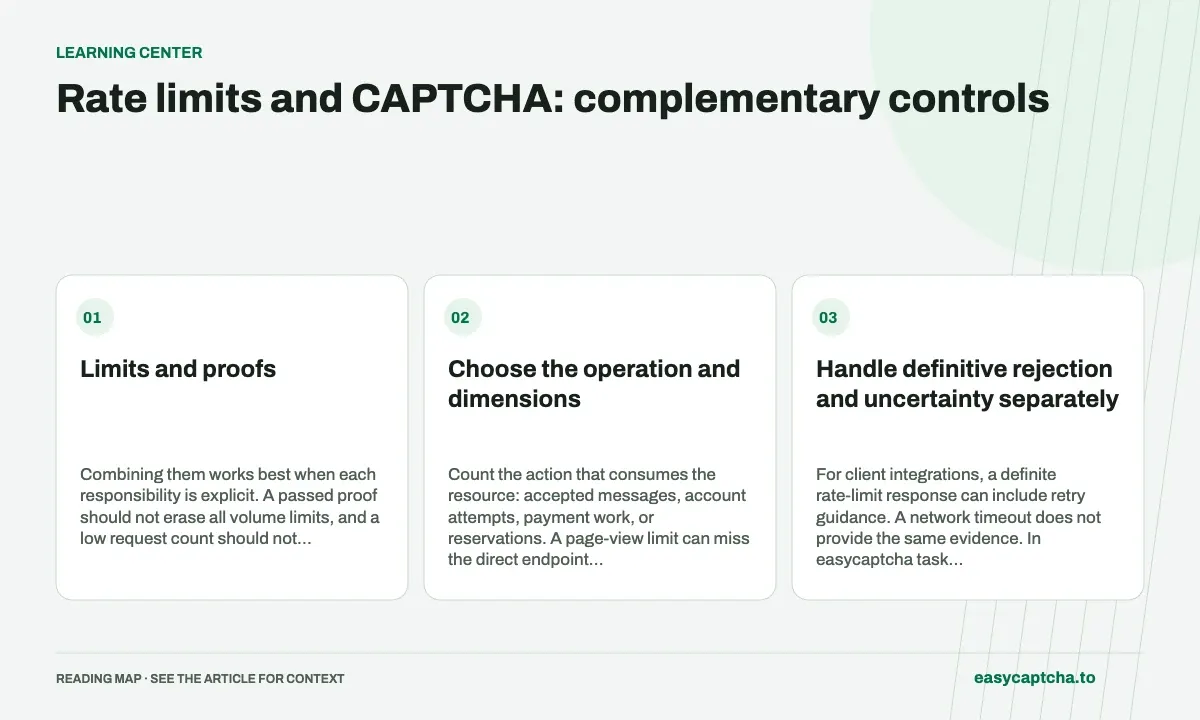
Limits and proofs
Combining them works best when each responsibility is explicit. A passed proof should not erase all volume limits, and a low request count should not automatically bypass a required proof.
Choose the operation and dimensions
Count the action that consumes the resource: accepted messages, account attempts, payment work, or reservations. A page-view limit can miss the direct endpoint that performs the action.
Consider the actor, session, account, destination, and network context appropriate to your application. One IP threshold can affect many legitimate visitors on a shared network. Document what the limit is intended to control and how visitors recover when it is reached.
Handle definitive rejection and uncertainty separately
For client integrations, a definite rate-limit response can include retry guidance. A network timeout does not provide the same evidence. In easycaptcha task creation, an ambiguous timeout can leave the submission outcome unknown; automatically repeating it can create additional work.
Retain known IDs and observe existing jobs instead of using new creations as a waiting strategy. Local queues should coordinate admitted work, not only simultaneous HTTP calls.
Evaluate false positives and expensive work
Monitor the actual resource cost and genuine completion. Lower traffic alone does not establish that the policy improved. Compare support contacts, recovery success, and whether abuse moved to an alternate route.
OWASP’s REST assessment guidance includes testing throttling around authentication and recovery. Use fail-closed verification for provider failures, and login controls for limits that protect account access without making legitimate recovery impossible.
Frequently asked questions
Can CAPTCHA replace request limits?
No. A proof and a limit constrain different aspects of a request. Applications can combine them while enforcing authorization and operation-specific rules.
Why can an IP-only rate limit cause problems?
Shared networks may contain many legitimate users, while distributed traffic can use many addresses. Evaluate additional identifiers and actual outcomes.
How do I start using the easycaptcha API?
Create an account and get an API key, then follow the getting-started guide. Submit recognition or token tasks through raw HTTP or the typed Python and JavaScript SDKs.