Evaluation methods
Evaluating a reCAPTCHA recognition integration before rollout
Evaluating a reCAPTCHA recognition integration before rollout. Measure recognition requests, workflow outcomes, and integration errors with clear criteria.
By the easycaptcha team · Published
Include full 3×3, full 4×4, and repeating challenges in a workflow you control. Track mode, round count, and task IDs. A trial containing only single-round grids cannot establish replacement handling quality.
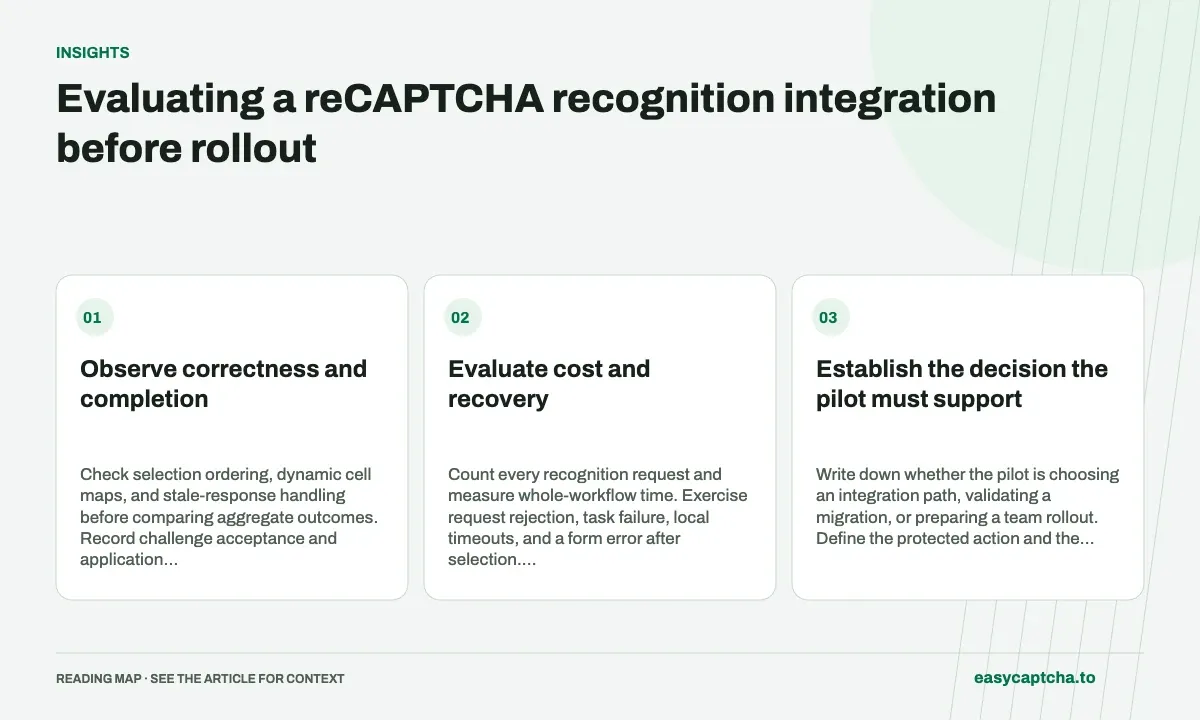
Observe correctness and completion
Check selection ordering, dynamic cell maps, and stale-response handling before comparing aggregate outcomes. Record challenge acceptance and application completion separately from API completion. Make unknown outcomes an explicit category.
Evaluate cost and recovery
Count every recognition request and measure whole-workflow time. Exercise request rejection, task failure, local timeouts, and a form error after selection. Choose a rollout based on completed workflows and understandable recovery behavior.
Establish the decision the pilot must support
Write down whether the pilot is choosing an integration path, validating a migration, or preparing a team rollout. Define the protected action and the observation that counts as completion. An API returning a valid array may be sufficient for a transport prototype but is insufficient evidence for a browser workflow that must finish a form.
Choose the environment and cohort before collecting outcomes. Keep browser version, integration release, plan state, and pricing options in the trial record. This makes a later difference interpretable and avoids comparing a free browser trial with a paid API experiment that measured a different endpoint of the process.
Cover behavior that a happy-path grid cannot reveal
| Case | Boundary being evaluated |
|---|---|
| Full 3×3 grid | Nine-value mapping |
| Full 4×4 grid | Sixteen-value geometry |
| Sparse dynamic replacements | Input-order mapping |
| All-false completed result | Valid negative decisions |
| Reset before completion | Freshness and stale-response handling |
| Local waiting deadline | Task identity and recovery |
| Form error after acceptance | Separation of final action from recognition |
Use local fixtures for deterministic mapping cases and a controlled integration sequence for capture and browser transitions. That combination produces clearer evidence than repeatedly submitting live challenges to rediscover an indexing error. Record which cases were exercised and which remain outside the pilot’s scope.
Report a small set of complete measurements
Track started workflows, all recognition requests, known accepted challenges, known final application outcomes, and unknown outcomes. Add total workflow time and replacement depth. For paid use, apply the actual effective rate and selected options to the same request cohort so the cost denominator matches the outcome report.
Keep counts next to percentages and disclose observation coverage. If many attempts end at a local deadline, a high acceptance rate among the remaining fast attempts may not describe the workflow users experience. The success-rate guide and latency guide explain how to retain those cases without inventing outcomes.
Make rollout criteria concrete and reviewable
Agree on the behavior required for expansion: correct mapping across supported modes, no application of stale results, understandable recovery after errors, and acceptable completion behavior in the observed cohort. Choose any quantitative targets based on the application’s requirements rather than presenting an arbitrary universal solver threshold.
At the review, list evidence, unresolved defects, and the remaining observation gaps. A small pilot can establish that the integration contract works without proving performance for every future challenge mix. Retain the fixtures and versioned setup guide so later releases can reproduce the same boundaries, then expand the cohort when the decision requires stronger evidence.
Distinguish contract validation from performance evidence
A small fixture suite can establish that request construction, result mapping, and stale-response rejection follow the intended contract. It does not establish a universal recognition acceptance rate. A live cohort can provide outcome evidence for its observed inputs, but it may still be too small or too narrowly selected to support broad performance claims.
Label these two kinds of evidence in the pilot report. List deterministic cases and their expected behaviors separately from live counts, latency distributions, cost assumptions, and unknown outcomes. This makes it clear which findings can be reproduced exactly and which depend on the sampled workflow. It also prevents a successful code-path test from becoming an unsupported marketing benchmark.
Before expansion, review whether the unresolved questions matter to the actual decision. A migration may require stronger compatibility evidence, while a team rollout may need better recovery instructions and configuration coverage. Gather the missing evidence deliberately rather than adding more repetitions of the easiest grid. Keep the final recommendation tied to the tested environment, observed outcomes, and clearly stated limits of the pilot.
Frequently asked questions
What should a reCAPTCHA pilot measure?
Measure selection mapping, challenge outcomes, observation coverage, total workflow time, and all recognition requests.
Which metrics belong in a recognition pilot?
Track all requests, replacement depth, known challenge and application outcomes, unknown outcomes, total workflow time, and applicable cost.
What should determine rollout readiness?
Use evidence of correct mapping, stale-result handling, clear recovery, and completion behavior in a stated representative cohort.