Bot fundamentals
Bots and automation: why intent matters
Distinguish useful automation from abusive behavior and choose controls around the operation being protected rather than labeling every automated client malicious.
By the easycaptcha team · Published
A browser test, monitoring client, accessibility tool, and spam bot can all automate interactions. The application must decide which actions are permitted and which behavior causes harm. Calling every automated request malicious obscures those policy decisions.
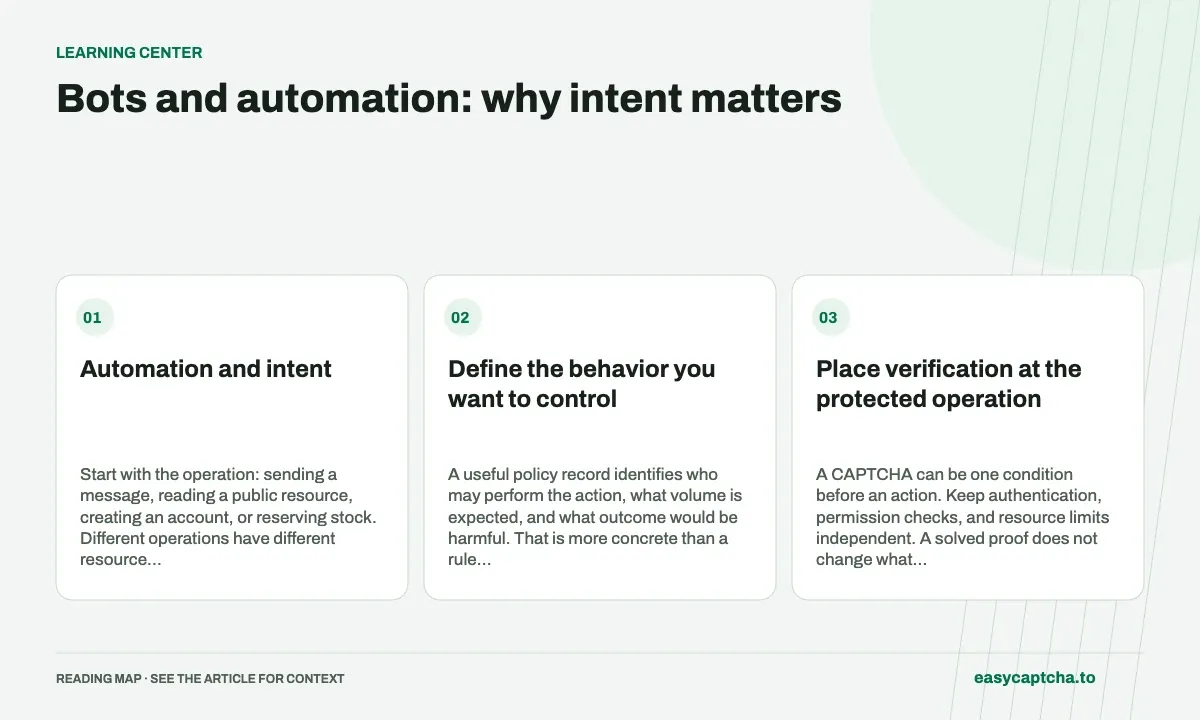
Automation and intent
Start with the operation: sending a message, reading a public resource, creating an account, or reserving stock. Different operations have different resource costs and authorization requirements. A rule suitable for one endpoint can be excessive or ineffective on another.
Define the behavior you want to control
A useful policy record identifies who may perform the action, what volume is expected, and what outcome would be harmful. That is more concrete than a rule saying only humans may use the site while the same company relies on automated tests and integrations.
| Observation | Question to investigate |
|---|---|
| High request volume | Is it authorized monitoring or abusive work? |
| Repeated form creation | Is it a valid bulk integration or unwanted accounts? |
| Unusual completion timing | Is the client broken, automated, or assistive? |
Treat those observations as signals for investigation rather than automatic conclusions about a person.
Place verification at the protected operation
A CAPTCHA can be one condition before an action. Keep authentication, permission checks, and resource limits independent. A solved proof does not change what the client is allowed to do.
Test direct requests and alternate routes as well as the visible webpage. A carefully designed widget cannot protect an endpoint that skips its verification result.
Measure useful outcomes
Review accepted abuse, legitimate completion, and support burden together. If all activity disappears after a change, the form may simply be unusable. Maintain a clear route for authorized clients and visitors who need assistance.
The OWASP bot-management guidance frames automated abuse as a set of application problems. Read verification basics and rate controls when translating that policy into endpoint behavior.
Frequently asked questions
Are all bots malicious?
No. Automation also powers monitoring, assistive tools, and routine integrations. Evaluate what an automated action does and whether it is permitted.
Does completing a CAPTCHA prove a request is harmless?
No. Verification supplies evidence for one step. Your application still needs authorization, validation, and controls on the requested operation.
How do I start using the easycaptcha API?
Create an account and get an API key, then follow the getting-started guide. Submit recognition or token tasks through raw HTTP or the typed Python and JavaScript SDKs.