Evaluation hygiene
What staging can prove about a CAPTCHA deployment
Keep deterministic fixtures, provider configuration, browser policy, and live checks distinct so passing staging tests are not overstated as production performance.
By the easycaptcha team · Published
Staging can establish application behavior against known verification outcomes. It does not automatically reproduce production challenge distribution, user devices, provider configuration, or traffic. Describe which conditions are shared and which are intentionally simplified.
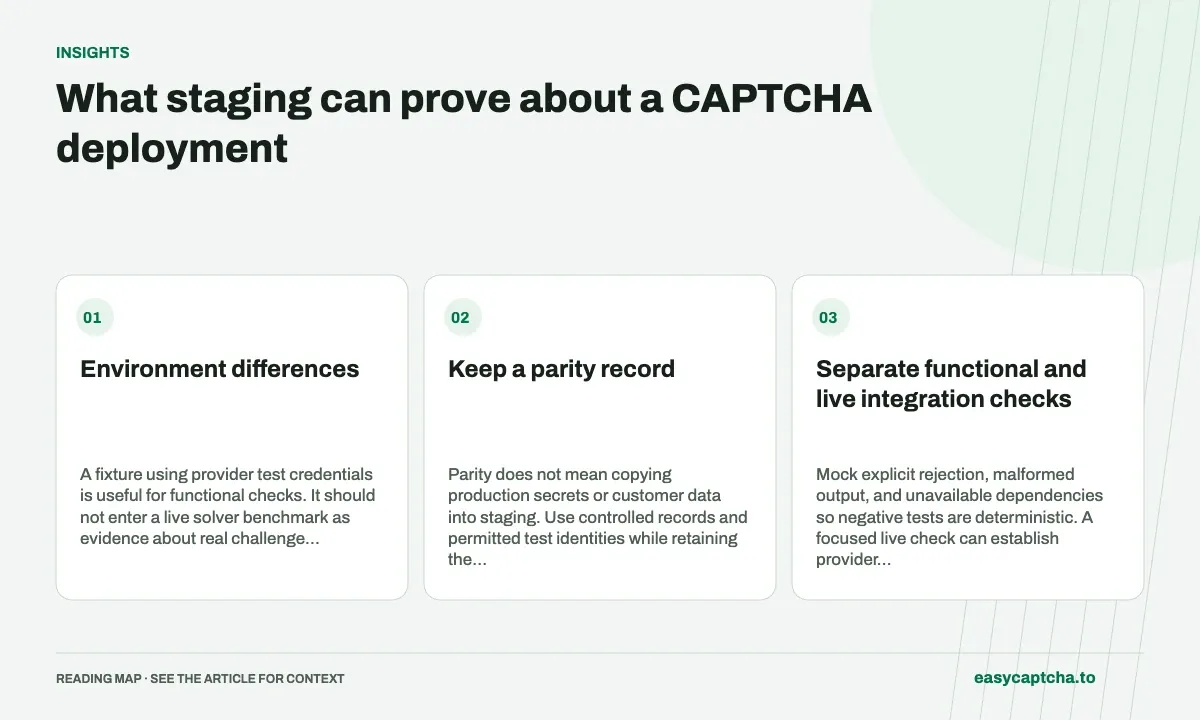
Environment differences
A fixture using provider test credentials is useful for functional checks. It should not enter a live solver benchmark as evidence about real challenge acceptance.
Keep a parity record
| Condition | What to compare |
|---|---|
| Protected operation | Same business and verification boundaries |
| Provider configuration | Correct environment-specific keys and policy |
| Browser policy | Script, frame, and network permissions |
| Releases | Application, browser, and extension versions |
| Outcome evidence | What establishes final acceptance |
Parity does not mean copying production secrets or customer data into staging. Use controlled records and permitted test identities while retaining the behavior relevant to the test.
Separate functional and live integration checks
Mock explicit rejection, malformed output, and unavailable dependencies so negative tests are deterministic. A focused live check can establish provider connectivity and configuration independently.
The live check should be bounded and use a reversible operation you own. Do not repeatedly create valuable records or messages in production merely to prove a widget renders.
Validate the deployment boundary
A correct source file does not prove a running process loaded its configuration. Test the built artifact and operational origin. A domain mismatch or blocked asset may appear only after deployment even when local tests passed.
Verify both positive completion and rejection without proof. Passing a frontend readiness test cannot establish that the actual endpoint enforces verification.
Testing credentials defines fixture limits, release testing organizes cases, and owned-flow monitoring shows how to keep availability, deterministic behavior, and live verification as separate forms of evidence rather than one overstated green result.
Frequently asked questions
Does passing staging prove production verification will work?
No. Staging proves the conditions it exercises. Domain settings, credentials, network context, and surrounding application behavior can differ.
What should I compare across environments?
Document the relevant configuration and flow boundaries, then test representative operations without copying private production payloads unnecessarily.
How can easycaptcha fit into my integration tests?
Use the documented recognition or token API for the hCaptcha stage, preserve task IDs, and inspect terminal results. Measure verifier acceptance and application completion separately from job completion.