Provider choices
reCAPTCHA vs hCaptcha recognition in easycaptcha
reCAPTCHA vs hCaptcha recognition in easycaptcha. Compare inputs, responsibilities, and limits before choosing your reCAPTCHA integration.
By the easycaptcha team · Published
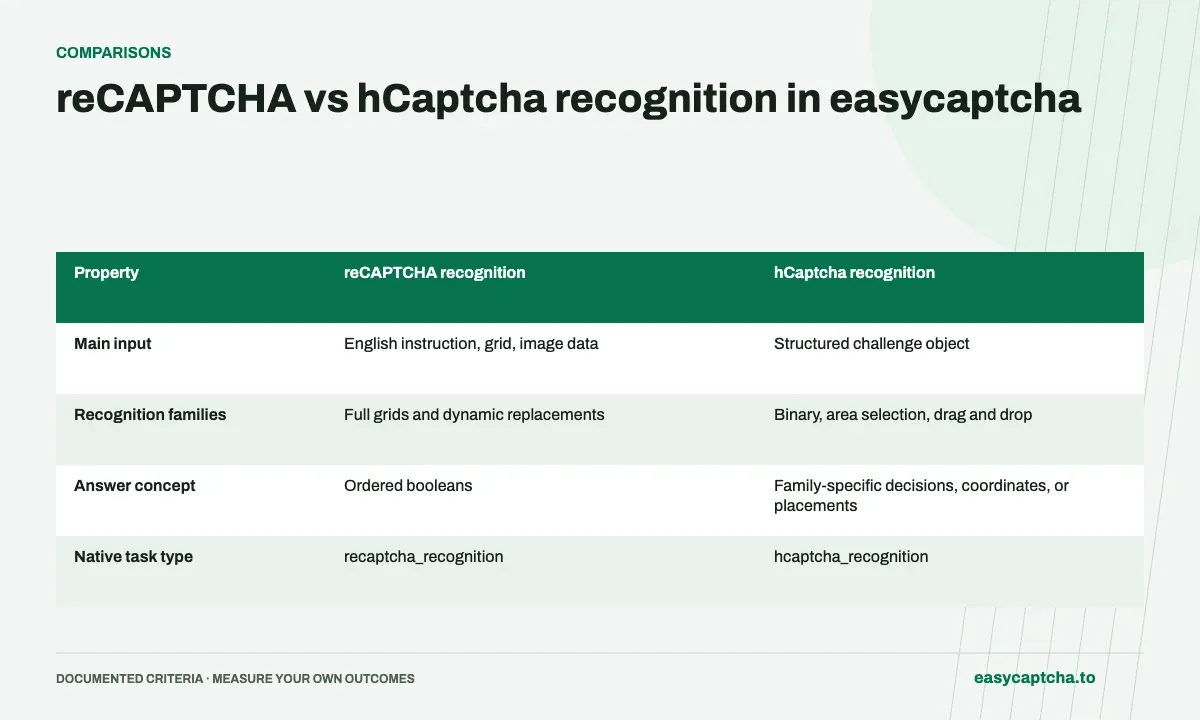
reCAPTCHA recognition uses an English instruction, a grid mode, and image data URIs. hCaptcha recognition accepts structured challenge objects for binary, area-selection, or drag-and-drop tasks. Provider choice determines the schema and answer model.
Compare recognition units
reCAPTCHA is billed once per recognition request, including each replacement round. hCaptcha uses its documented recognition group rules. Do not compare the number of screen interactions as if both providers always consume the same units.
Reuse lifecycle code carefully
Both providers share the create/get task lifecycle and common options, but input preparation and result mapping differ. Share transport and polling code while keeping provider-specific validation. The extension has independent provider switches and a shared free allowance.
Compare input and answer models
| Property | reCAPTCHA recognition | hCaptcha recognition |
|---|---|---|
| Main input | English instruction, grid, image data | Structured challenge object |
| Recognition families | Full grids and dynamic replacements | Binary, area selection, drag and drop |
| Answer concept | Ordered booleans | Family-specific decisions, coordinates, or placements |
| Native task type | recaptcha_recognition |
hcaptcha_recognition |
A common HTTP lifecycle does not imply a common recognition schema. If your client already handles hCaptcha, adding reCAPTCHA should start with a separate provider request branch. Reusing an object that happens to contain a field called task can erase the difference between a structured challenge and a text instruction.
Share transport while preserving provider-specific validation
Authentication, task ID persistence, retrieval, and handling of queued or running states can be shared. Input validation and completed-result interpretation need to follow the actual provider and recognition family. A boolean grid result cannot be applied by a function expecting area coordinates or draggable entity identities.
Use a provider discriminator in internal records, and retain the submitted task type with each task ID. At completion, dispatch to the appropriate result validator and mapping code. This is more reliable than deciding which provider produced a response based on whichever widget happens to be visible when an asynchronous lookup finishes.
Compare billing units using concrete work
reCAPTCHA recognition is billed once per request, including separate dynamic rounds. hCaptcha uses recognition groups: nine binary tiles form a group, while area-selection and drag/background images follow their documented per-image rules. A visible challenge is therefore not a consistent cross-provider billing unit.
For example, an hCaptcha binary challenge with eighteen tiles uses two recognition groups. A reCAPTCHA dynamic batch with several replacement images is one request. These examples illustrate unit definitions, not relative cost or expected difficulty. Apply the separate effective provider rates and count actual units before drawing conclusions about spend.
Review browser configuration and evaluation cohorts
The extension exposes independent hCaptcha and reCAPTCHA switches, with Global controlling overall assistance. Its Free plan allowance is shared across providers. A session can therefore consume remaining allowance on one provider before the next provider appears, even though that second widget has not yet been assisted that day.
For evaluation, segment outcomes by provider and recognition family, then report complete workflows using clearly defined denominators. A mixed average can conceal a mapping regression in one family. Use the hCaptcha recognition types guide alongside the reCAPTCHA grid guide to understand the different inputs before comparing results.
Build provider-aware reporting before comparing totals
Store the provider, recognition family, and billing unit with each task record. For reCAPTCHA, also retain grid mode and whether the request was an initial full grid or a dynamic replacement. For hCaptcha, preserve the family-specific context needed to explain recognition groups. This allows a mixed account’s usage to be reconciled without treating every task as the same amount of work.
When reporting team browser use, explain that provider switches are independent but the free allowance is shared. A tester who used hCaptcha earlier can have less remaining allowance when reCAPTCHA first appears. That is plan behavior, not evidence that one provider’s switch is broken or that the second provider received its own unused daily allocation.
For outcome comparisons, use matched observation rules and retain unknown outcomes. A dataset with mostly single-round reCAPTCHA grids and complex hCaptcha drag challenges cannot establish a general provider ranking from raw completion percentages. Describe the actual cohort and answer contracts first. Use the comparison to guide integration choices and diagnosis rather than to make unsupported claims about universal difficulty or quality.
Frequently asked questions
Can I use an hCaptcha structured task as reCAPTCHA input?
No. Use the reCAPTCHA instruction, grid, and image_data schema.
Which integration code can be shared between providers?
Authentication, task ID persistence, and status observation can share infrastructure. Keep provider-specific input and result validation separate.
Are recognition units identical across providers?
No. reCAPTCHA counts requests, while hCaptcha uses its documented recognition group rules. Apply each provider rate to the appropriate units.