Solver comparison
easycaptcha vs Salamoonder: challenge jobs and anti-bot workflows
Compare easycaptcha hCaptcha recognition and tokens with Salamoonder documented API and SDK workflows, keeping input and result boundaries explicit.
By the easycaptcha team · Published
Salamoonder’s official introduction presents API solving and an SDK for tasks requiring additional input. Its task documentation should be reviewed for the specific workflow you need. easycaptcha’s customer contract focuses on hCaptcha recognition and tokens.
Supported workloads
A broader anti-bot workflow and a structured image-recognition request may both be called solving, but they can require different application state and return different artifacts. Compare an explicit operation rather than a product slogan.
Document the boundary of each integration
For your evaluation, record the input your application must supply, the output it receives, and the steps it still owns. A response token, browser cookie, sensor payload, and image coordinates are not interchangeable results.
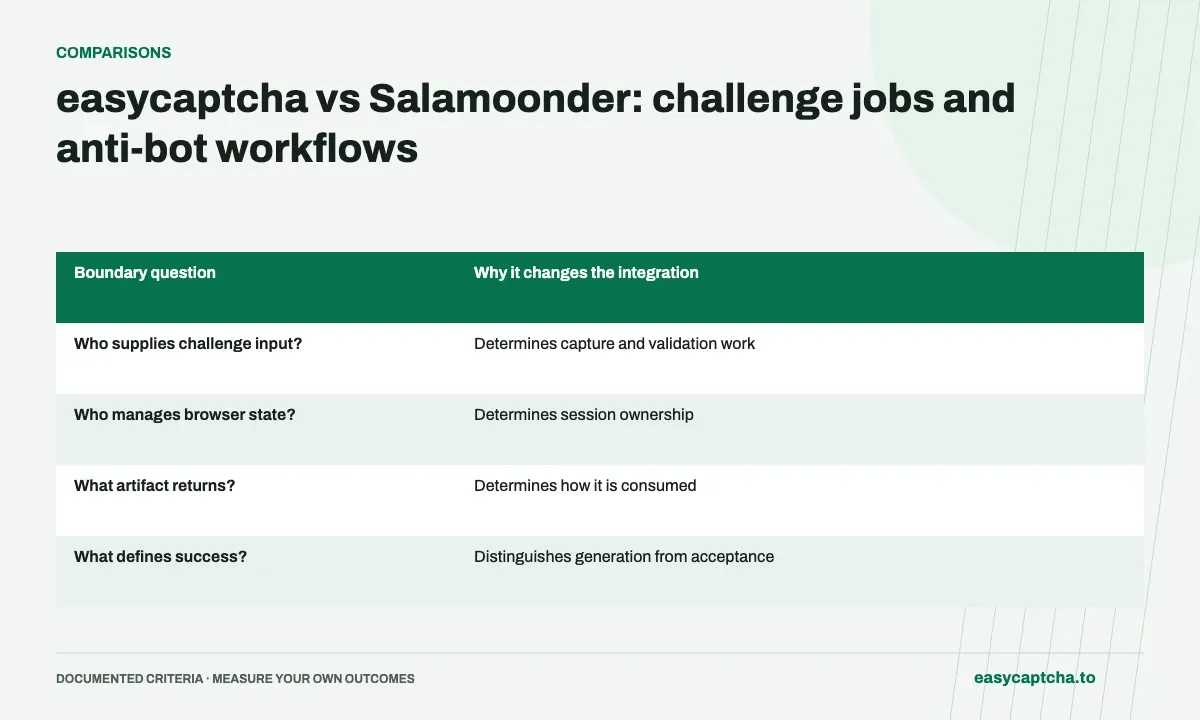
| Boundary question | Why it changes the integration |
|---|---|
| Who supplies challenge input? | Determines capture and validation work |
| Who manages browser state? | Determines session ownership |
| What artifact returns? | Determines how it is consumed |
| What defines success? | Distinguishes generation from acceptance |
Use Salamoonder’s task-specific reference for answers instead of inferring behavior from an aggregator listing. An aggregator can adapt a provider and therefore expose a different contract from the direct service.
Treat SDK convenience separately from guarantees
A short SDK call can hide input gathering, multiple requests, or waiting. Check deadlines, cleanup, and error behavior before making it part of a worker. For easycaptcha, save accepted IDs and retrieve the same jobs after observation fails.
Compare the costs of the actual outputs and include additional application work in the evaluation. Do not repeat unverified speed or savings claims as measured facts.
This page is written by the easycaptcha team and compares integration boundaries. Recognition versus tokens explains easycaptcha outputs, while routing evaluation helps distinguish a direct provider contract from an intermediary’s adapted interface.
Frequently asked questions
Why match the workload before comparing Salamoonder and easycaptcha?
The services' documented task scopes and input requirements can differ. A brand comparison is useful only after identifying the operation needed.
What is the public easycaptcha customer API focused on?
It offers hCaptcha recognition, regular token jobs, and enterprise token jobs for accounts with explicit enterprise access.
How can I evaluate easycaptcha on my own workload?
Start with a small integration trial using representative hCaptcha tasks. Compare observed acceptance, final outcomes, and costs in the actual billing unit rather than relying on a feature table alone.