Solver comparison
easycaptcha vs Solverify: typed results and anti-bot artifacts
Compare task states, credential placement, and result families in easycaptcha and Solverify, including tokens, cookies, headers, and OCR.
By the easycaptcha team · Published
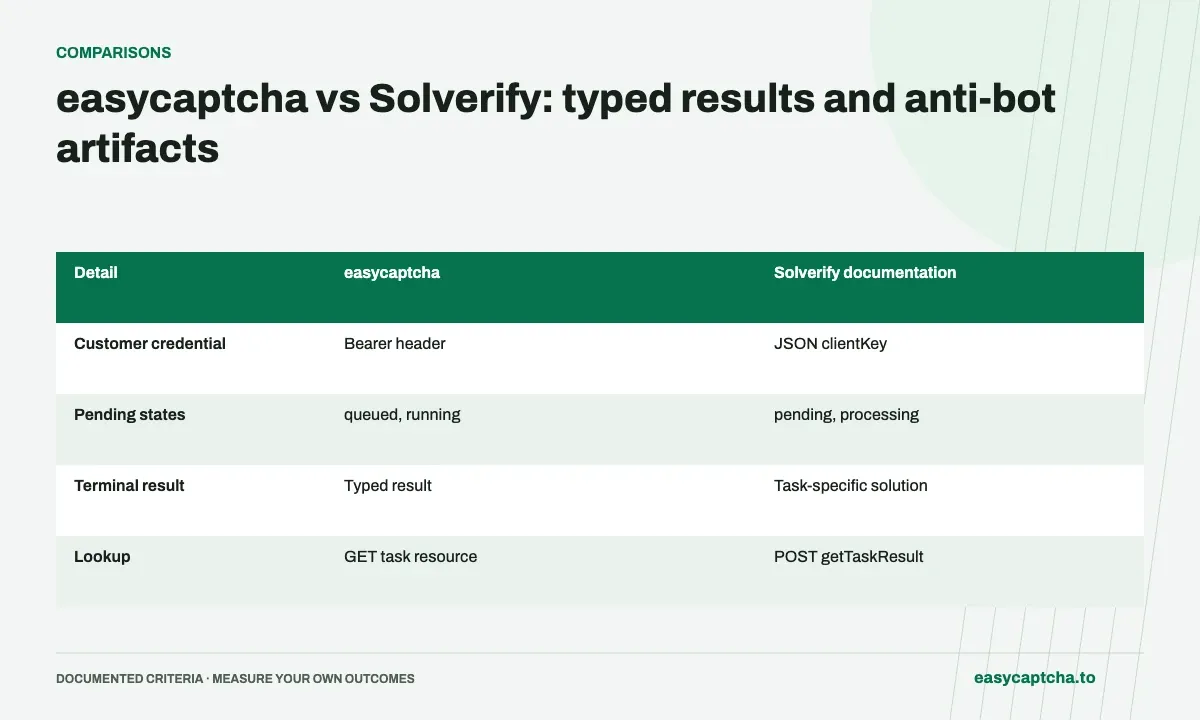
Solverify’s official API documentation describes asynchronous tasks returning artifacts such as tokens, cookies, headers, or OCR text. Its documented API host uses the spelling solver.solverify.net. easycaptcha returns typed hCaptcha recognition or token results through a task resource.
Result types
Copy the documented host carefully. A similarly spelled display name, domain, or API identifier should not be normalized by guesswork.
Map state and authentication
| Detail | easycaptcha | Solverify documentation |
|---|---|---|
| Customer credential | Bearer header | JSON clientKey |
| Pending states | queued, running | pending, processing |
| Terminal result | Typed result |
Task-specific solution |
| Lookup | GET task resource | POST getTaskResult |
The Solverify reference notes that customer-facing errors can be represented in a JSON body even with HTTP 200. Your integration must inspect the body as well as the transport status. easycaptcha also distinguishes an embedded failed job from a failed HTTP request.
Keep artifact handling task-specific
A generic string field in an adapter can hide whether the output is a token, a cookie value, or recognized text. Preserve a discriminator and explicit required context. Otherwise the application can count a generated artifact as a completed action without ever consuming it correctly.
Confirm current coverage directly before treating one provider’s task as equivalent to another’s hCaptcha flow. Network requirements and enterprise access need their own validation.
Test failure paths and billed outcomes
Include invalid input, pending work, failed work, and a transport interruption before creation returns an ID. Keep uncertainty separate from definitive failure; broad retry middleware can duplicate paid tasks.
This comparison is authored by the easycaptcha team from the linked reference. It does not establish comparative accuracy or speed. Read task recovery for persistence and SDK versus raw HTTP for deciding where task-specific contracts should live in your application.
Frequently asked questions
Why compare result families before changing providers?
Your software may need image-level answers or a token. A result from another family cannot simply be substituted into that workflow.
What should I preserve in an easycaptcha recognition integration?
Preserve original task keys, question data, and challenge media as data URIs. Apply the keyed result according to its recognition family.
How can I evaluate easycaptcha on my own workload?
Start with a small integration trial using representative hCaptcha tasks. Compare observed acceptance, final outcomes, and costs in the actual billing unit rather than relying on a feature table alone.