Task comparison
Image recognition vs token solving for hCaptcha
Choose between structured image answers and a verification token by the output your integration actually consumes, not by a solver marketing label.
By the easycaptcha team · Published
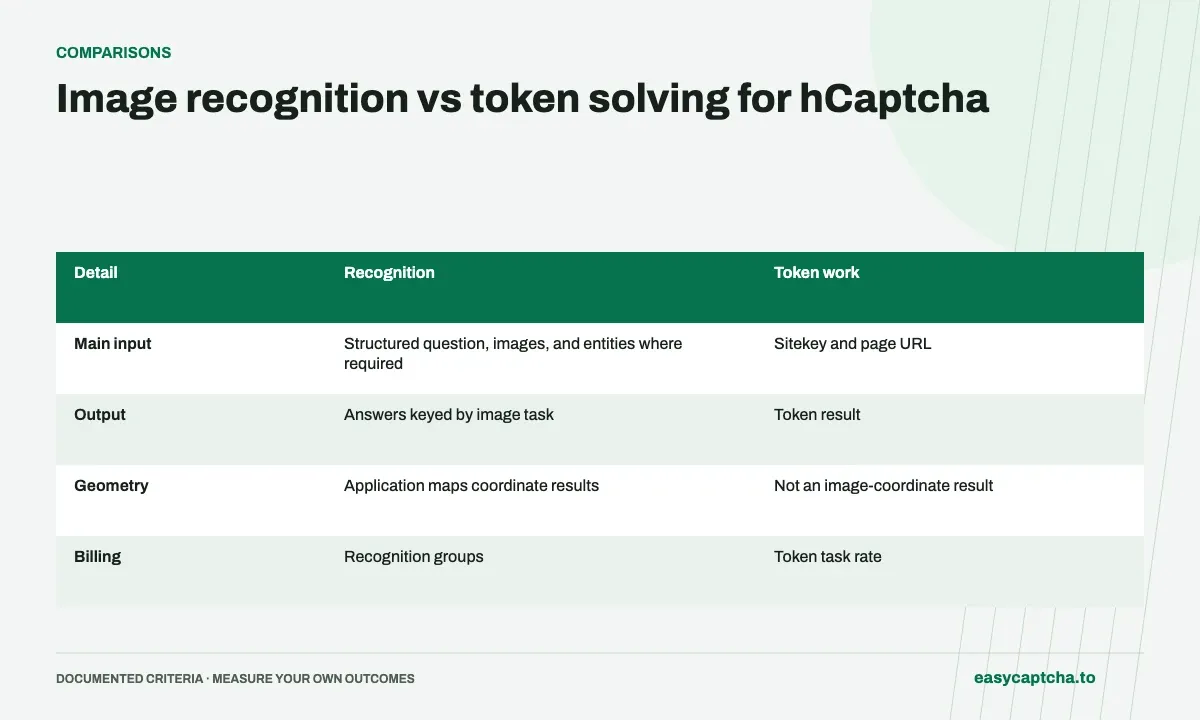
Recognition interprets a supplied challenge. Token solving returns a proof value for an integration. In easycaptcha, these are separate task types with separate request and result schemas. A recognition job does not become a token job because a sitekey was attached for statistics.
Outputs and responsibilities
Choose by the next step in your application: applying tile labels or coordinates requires recognition data, while a token-consuming integration requires a token result and its surrounding configuration.
Compare the data your application supplies
| Detail | Recognition | Token work |
|---|---|---|
| Main input | Structured question, images, and entities where required | Sitekey and page URL |
| Output | Answers keyed by image task | Token result |
| Geometry | Application maps coordinate results | Not an image-coordinate result |
| Billing | Recognition groups | Token task rate |
Enterprise token work adds a separate type, required data, and account permission. The API reference supplies exact fields instead of an approximate universal request.
Avoid a generic solution-string abstraction
A wrapper returning only string loses important distinctions. It can hide whether a returned value is a proof, a text answer, or serialized coordinates. Preserve the task discriminator and handle completed results by type.
The same principle applies to failure. Check terminal status before reading results, and distinguish a valid failed snapshot from a transport problem. Keep task IDs so a pending operation can be retrieved without creating replacement work.
Measure acceptance where the answer is used
A completed recognition job proves that answers were returned, not that they were applied to the correct image geometry. A token result proves that a value arrived, not that the verifier accepted it. Record the downstream outcome for either path.
See binary recognition, drag-and-drop mapping, and token concepts. Compare costs in their actual units rather than labeling both results one solve and ignoring how much work that label hides.
Frequently asked questions
Does image recognition return an hCaptcha token?
No. Recognition returns answers keyed to the submitted challenge tasks. Token solving returns a token in result.token after completion.
Which task type should my integration choose?
Choose based on the required output. Recognition needs the structured challenge and data URI media; token tasks need the documented sitekey and page context.
How do I start using the easycaptcha API?
Create an account and get an API key, then follow the getting-started guide. Submit recognition or token tasks through raw HTTP or the typed Python and JavaScript SDKs.