Solver comparison
easycaptcha vs RiskByPass: interpreting a task-console contract
Compare easycaptcha documented task resources with the RiskByPass public task console, and distinguish directly verified interface details from directory claims.
By the easycaptcha team · Published
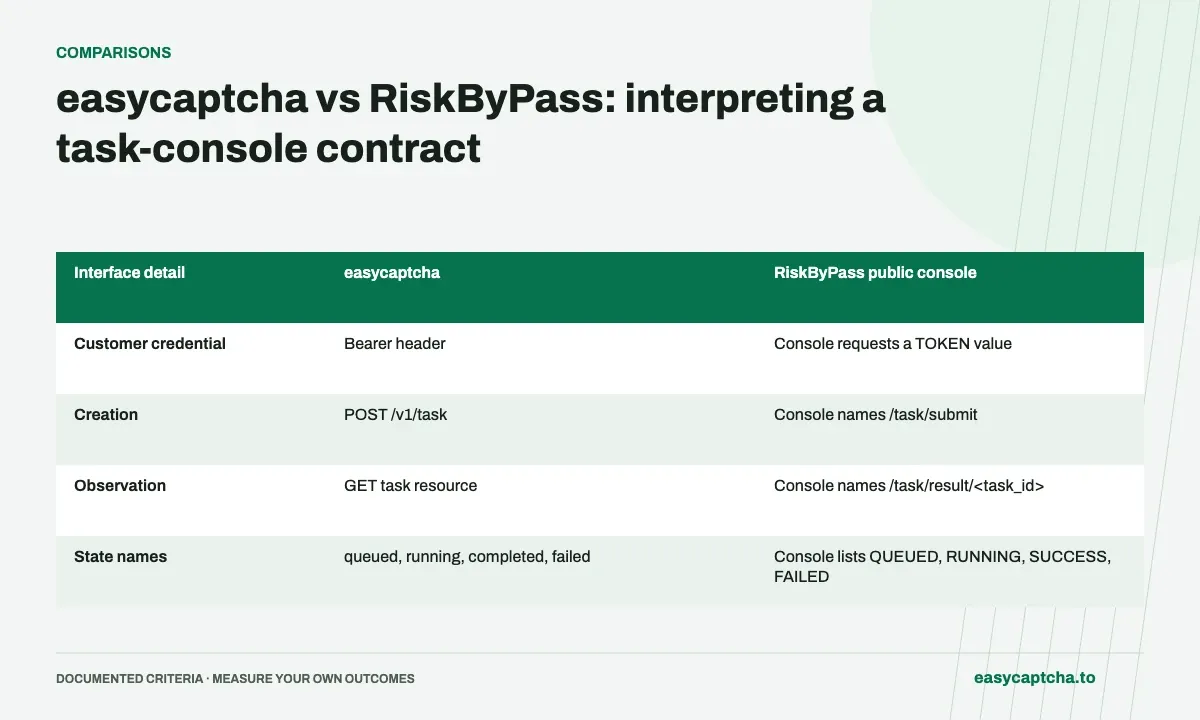
RiskByPass appears in AnySolver’s provider directory, but a directory is not the same evidence as the direct service’s contract. Its public task console describes task submission and result polling. The console is the primary evidence used here; it is narrower than a complete task-specific API reference.
Direct interfaces
easycaptcha publishes a typed customer API with hCaptcha recognition, regular tokens, and approved enterprise tokens. This page is written by the easycaptcha team and does not claim measured superiority for either service.
Compare only what the evidence establishes
| Interface detail | easycaptcha | RiskByPass public console |
|---|---|---|
| Customer credential | Bearer header | Console requests a TOKEN value |
| Creation | POST /v1/task | Console names /task/submit |
| Observation | GET task resource | Console names /task/result/<task_id> |
| State names | queued, running, completed, failed | Console lists QUEUED, RUNNING, SUCCESS, FAILED |
These console details do not establish every accepted payload, task family, account entitlement, or billing rule. Obtain a current task-specific reference before implementing paid work. Do not guess those fields from another service’s similar endpoint names.
Verify task scope separately
AnySolver’s RiskByPass listing is useful discovery evidence for its routed integration. It does not prove that a direct API accepts the same normalized fields or exposes the same task names. An intermediary can adapt the provider’s interface.
For a hCaptcha workload, ask for the exact currently supported recognition or token operation and its required input. A generic solver console does not establish hCaptcha coverage. Keep unknown availability visible rather than filling a comparison table with an inferred yes.
Plan credential and recovery boundaries
A console that fills a credential field for the user is convenient, but request logs may then contain that credential in JSON. Review redaction according to the actual placement. Keep account credentials distinct from public challenge configuration.
Persist returned task IDs and translate state names explicitly. An interrupted creation can remain uncertain; submitting replacement work through another route may duplicate paid activity.
Evaluate the confirmed operation
Once a current contract is available, test equivalent authorized application attempts and record result generation, observed acceptance, final action, latency, and actual cost units. Publish unresolved observations rather than treating a later successful retry as proof about the original attempt.
The directory records discovery sources. AnySolver comparison explains routing boundaries, and fair evaluation separates directly documented features from measured outcomes.
Frequently asked questions
Should I choose a provider from a directory ranking alone?
No. Verify its direct interface and task requirements, then test your intended workload. Discovery and measured evaluation are separate steps.
What should an easycaptcha trial record?
Record task IDs, terminal status, verification acceptance where observed, final application outcomes, and the associated costs.
How can I evaluate easycaptcha on my own workload?
Start with a small integration trial using representative hCaptcha tasks. Compare observed acceptance, final outcomes, and costs in the actual billing unit rather than relying on a feature table alone.