Market analysis
How to compare CAPTCHA vendors without inventing a winner
Match operations, disclose authorship and cohorts, preserve unknown outcomes, and distinguish documented features from controlled trial results.
By the easycaptcha team · Published
A primary API reference can establish credential placement, task fields, or documented result states. It does not establish that one vendor is faster or more accurate on your application’s workload. Keep the published-contract comparison separate from measurements.
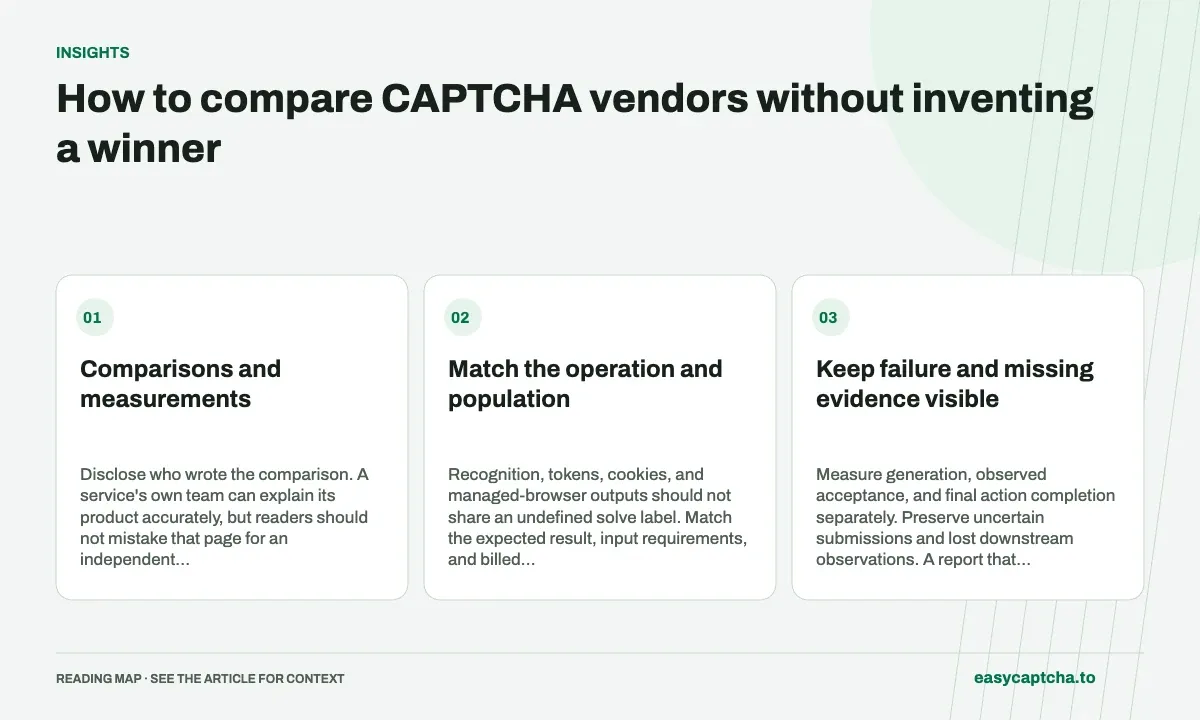
Comparisons and measurements
Disclose who wrote the comparison. A service’s own team can explain its product accurately, but readers should not mistake that page for an independent laboratory report.
Match the operation and population
Recognition, tokens, cookies, and managed-browser outputs should not share an undefined solve label. Match the expected result, input requirements, and billed unit. Confirm current task coverage instead of relying on old SDK classes or a directory listing.
State the site configurations, challenge families, environments, selected modes, and collection procedure. Live attempts may sample similar rather than identical challenges; disclose that limitation.
Keep failure and missing evidence visible
Measure generation, observed acceptance, and final action completion separately. Preserve uncertain submissions and lost downstream observations. A report that deletes hard unknown cases can improve a headline without improving the application.
Use a fixed observation window and a later reconciliation pass where useful. Keep raw denominator counts next to percentages so readers can assess the scope of the trial.
Compare real cost and latency
Count all paid work caused by the intended action, including retries and fallbacks, with applicable adjustments. Separate client observation delay from remote work when timing evidence permits it.
Use current vendor pricing for the actual unit and document when it was checked. Do not publish invented performance numbers or treat a vendor marketing claim as a measured trial result.
Publish a reviewable conclusion
Explain the tested scope, observed differences, unresolved conditions, and what would change the decision. If evidence is weak, say the trial did not establish a winner rather than filling the gap with a ranking.
The directory supplies research starting points, cohort design defines inclusion, and cost per outcome helps keep financial conclusions tied to the same observed application population.
Frequently asked questions
Does an API feature table establish solver performance?
No. It compares documented capabilities or contracts. Performance claims require a defined workload, measurements, and outcome criteria.
What makes a provider evaluation fair?
Use comparable populations, consistent observation rules, relevant costs, and explicit unknown outcomes. Separate contract comparisons from measured results.
How can I evaluate easycaptcha on my own workload?
Start with a small integration trial using representative hCaptcha tasks. Compare observed acceptance, final outcomes, and costs in the actual billing unit rather than relying on a feature table alone.