Solver comparison
easycaptcha vs AnySolver: direct tasks or provider routing
Compare a direct hCaptcha task integration with an aggregator that routes work across providers, including recovery, billing, and attribution questions.
By the easycaptcha team · Published
AnySolver presents a unified API and balance that routes work to upstream providers. Its introduction explains that model. easycaptcha offers its own customer contract for hCaptcha recognition, regular tokens, and approved enterprise tokens.
Direct services and aggregators
An aggregator can centralize several provider relationships. A direct integration keeps your application’s relationship with that service explicit. Neither shape establishes a better outcome on your workload without evaluation.
Compare the operational boundary
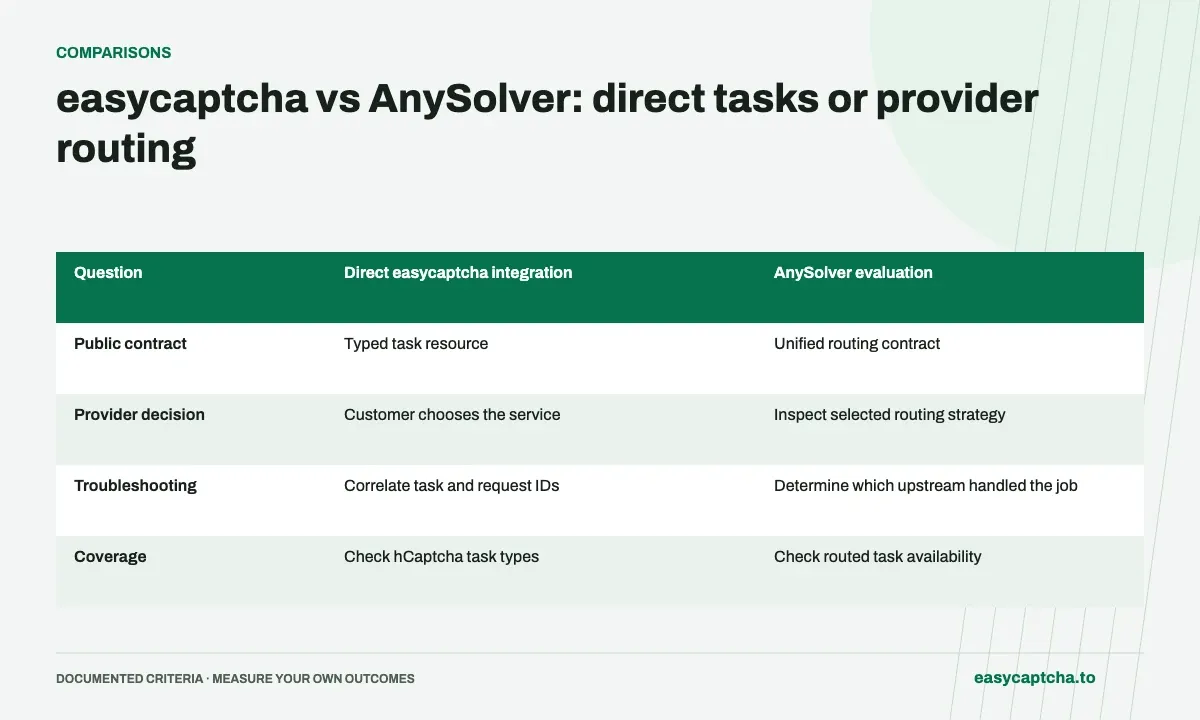
| Question | Direct easycaptcha integration | AnySolver evaluation |
|---|---|---|
| Public contract | Typed task resource | Unified routing contract |
| Provider decision | Customer chooses the service | Inspect selected routing strategy |
| Troubleshooting | Correlate task and request IDs | Determine which upstream handled the job |
| Coverage | Check hCaptcha task types | Check routed task availability |
AnySolver documents routing strategies and a provider directory. Review the current routing reference instead of assuming a cheapest or fastest label uses the criteria your application would choose.
Evaluate recovery before fallback
If an upstream request becomes uncertain, sending equivalent work through another provider can create two paid operations. Your adapter needs to distinguish a definitive failure from the loss of an observation. Keep IDs, selected provider information when available, and the point at which your application stopped waiting.
Track routing changes alongside outcomes. An aggregate acceptance rate can shift when the provider mix changes even if each provider’s behavior remains stable. Pricing must use the billed operation and routing terms, not a directory’s guessed common unit.
This comparison is written by the easycaptcha team from published documentation. It does not reproduce AnySolver’s marketing performance claims. Read routing evaluation for a controlled trial and the API reference for easycaptcha’s direct contract.
Frequently asked questions
How does a direct easycaptcha integration differ from an aggregator?
A direct integration uses easycaptcha's service contract. An aggregator introduces its own routing, interface, and commercial terms, which need separate evaluation.
What should I measure when comparing a direct service with an aggregator?
Measure the workload you actually send, its observed acceptance, failure handling, and total cost. Document which interface and routing policy were used.
How can I evaluate easycaptcha on my own workload?
Start with a small integration trial using representative hCaptcha tasks. Compare observed acceptance, final outcomes, and costs in the actual billing unit rather than relying on a feature table alone.