Account abuse
Account enumeration: what a CAPTCHA does not fix
Understand how authentication and recovery responses can reveal account existence, and review response behavior independently of visitor verification.
By the easycaptcha team · Published
Account enumeration occurs when an application reveals whether an identifier belongs to an account. Different response messages are one route; timing, status codes, or follow-up behavior can also create observable differences. The OWASP authentication guidance addresses enumeration risks in login behavior.
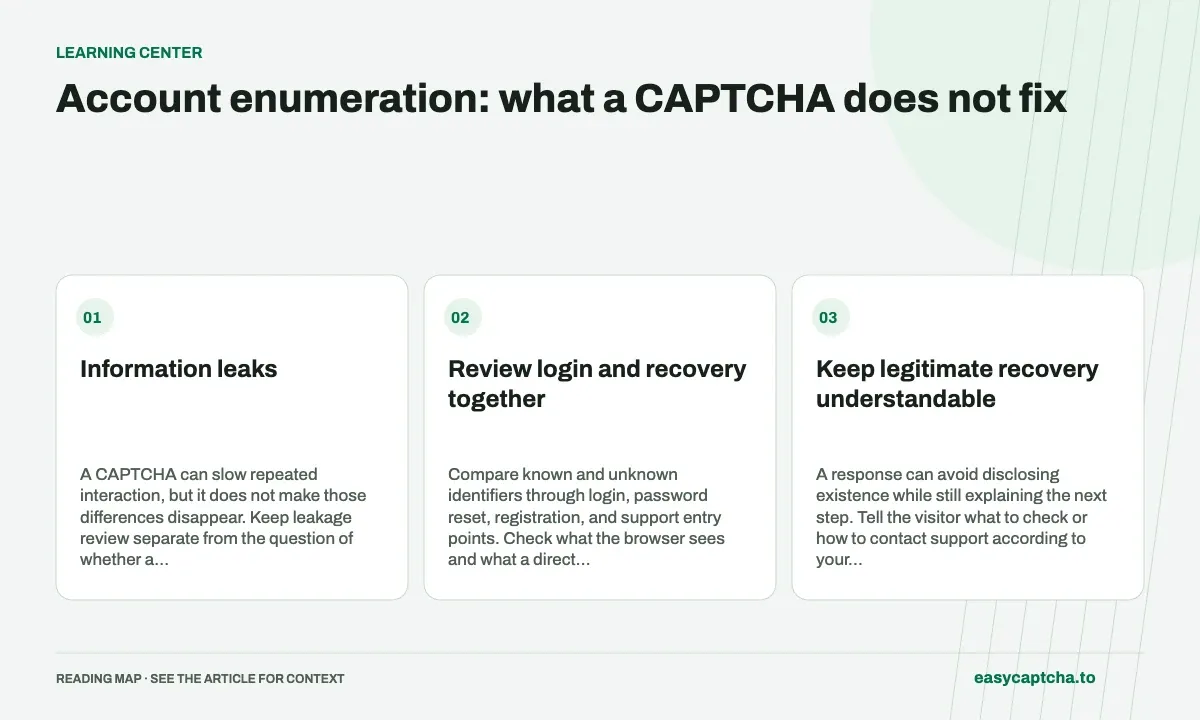
Information leaks
A CAPTCHA can slow repeated interaction, but it does not make those differences disappear. Keep leakage review separate from the question of whether a challenge was required.
Review login and recovery together
Compare known and unknown identifiers through login, password reset, registration, and support entry points. Check what the browser sees and what a direct client receives. A generic visible message is not sufficient if the endpoint exposes a distinct body or status underneath it.
Do not use real customers as a test dataset. Create representative test accounts and controlled nonexistent identifiers so the evaluation establishes behavior without exposing people’s information.
Keep legitimate recovery understandable
A response can avoid disclosing existence while still explaining the next step. Tell the visitor what to check or how to contact support according to your policy, without returning a different public answer for an arbitrary known account.
Review email side effects and timing carefully. Recovery should remain usable for the genuine account owner, and rate controls should not make the support route another inaccessible challenge loop.
Verify the boundary after changes
Test missing or rejected proofs, a repeated identifier, a malformed request, and a normal recovery attempt. Ensure an error handler does not accidentally expose more detail than the successful path.
Monitor aggregate abuse and completion rather than logging every attempted identity in broadly accessible analytics. A proof’s success state does not establish account ownership. Read password-reset abuse, brute-force attempts, and MFA’s separate role for related account controls.
Frequently asked questions
Can identical login errors still reveal whether an account exists?
Yes. Response timing, status codes, reset messages, and other observable differences can disclose account existence even when the visible error is identical.
Does CAPTCHA eliminate account enumeration?
No. Review what each account endpoint reveals and how requests are limited. A challenge is one control within that flow.
How can easycaptcha fit into my integration tests?
Use the documented recognition or token API for the hCaptcha stage, preserve task IDs, and inspect terminal results. Measure verifier acceptance and application completion separately from job completion.