Solver comparison
easycaptcha vs SolveCaptcha: task resources and classic endpoints
Compare easycaptcha typed jobs with SolveCaptcha classic submission and retrieval, including request names, credential exposure, and migration testing.
By the easycaptcha team · Published
This page compares easycaptcha with SolveCaptcha at solvecaptcha.com. A similarly named domain is not automatically the same service. Its official API reference documents classic in.php submission and res.php result retrieval.
Service identity
easycaptcha uses a typed JSON task resource with customer authentication in a Bearer header. A client built for classic form fields should not be migrated by changing only its hostname.
Map request fields into operations
The SolveCaptcha documentation names provider-specific fields for its classic interface. easycaptcha uses a task discriminator and structured input. Translate by operation: recognition, a provider token, and a browser-cookie result are different outputs.
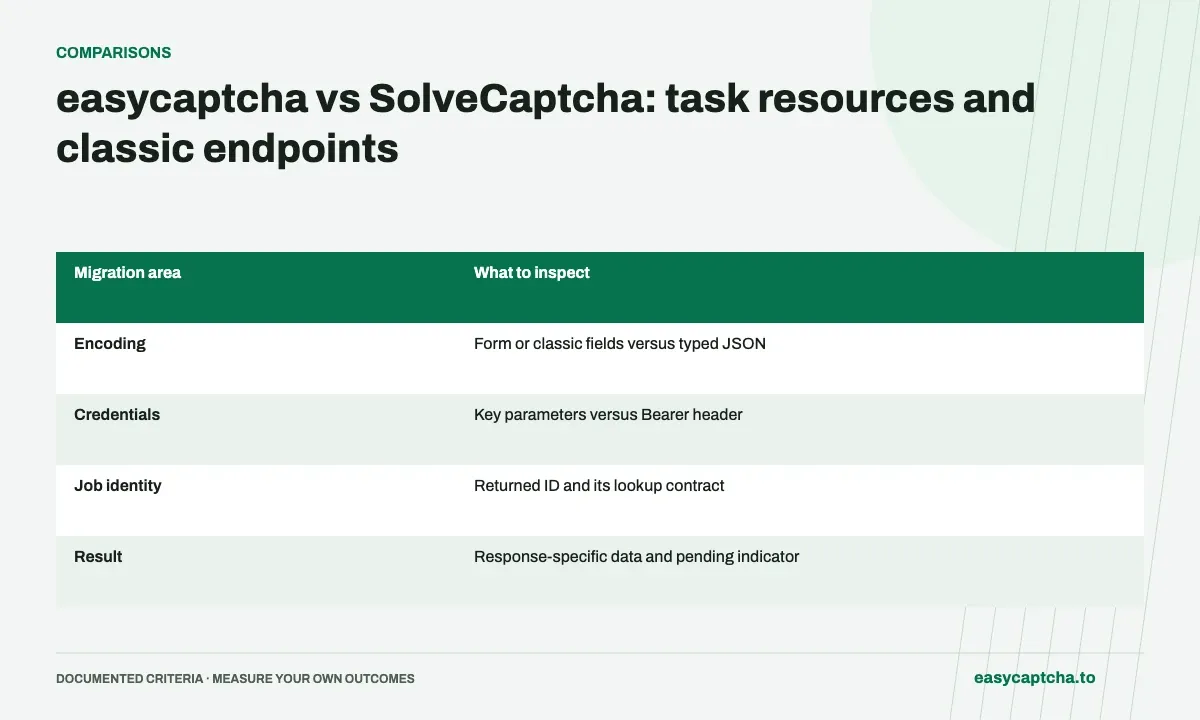
| Migration area | What to inspect |
|---|---|
| Encoding | Form or classic fields versus typed JSON |
| Credentials | Key parameters versus Bearer header |
| Job identity | Returned ID and its lookup contract |
| Result | Response-specific data and pending indicator |
A JSON output option on a classic endpoint does not make its input equivalent to another vendor’s createTask body. Follow the vendor’s exact reference.
Review stored URLs and logs
Credential-bearing query strings can enter access logs or copied support transcripts. When changing clients, remove assumptions that a request URL is always safe to record. Also redact proxy passwords and returned proof values if they are included in diagnostics.
Preserve task IDs before polling. If creation times out, its outcome may be uncertain; do not submit again merely because a client expected a result quickly. A later lookup for a known ID is a separate operation.
Evaluate a migration on its own evidence
Test schema conversion with fixtures, then test an authorized representative workflow. Compare completion, observed acceptance, and actual billed units rather than claiming that similar endpoint sequences imply equal outcomes.
This comparison is written by the easycaptcha team. See curl integration for inspecting easycaptcha HTTP responses and recovery design for process restarts and ambiguous submissions.
Frequently asked questions
Why verify the exact SolveCaptcha service and domain?
Similar names can lead to the wrong documentation or integration. Establish the actual service and contract before comparing requests and results.
Can I compare providers using one generic request object?
Use explicit adapters for each contract. Authentication, task structure, states, and outputs may differ even when the intended workload is similar.
How can I evaluate easycaptcha on my own workload?
Start with a small integration trial using representative hCaptcha tasks. Compare observed acceptance, final outcomes, and costs in the actual billing unit rather than relying on a feature table alone.