Solver comparison
easycaptcha vs NSLSolver: job IDs or a held solve request
Compare hCaptcha task resources with NSLSolver documented single-request solving, including supported providers, connection lifetimes, and recovery questions.
By the easycaptcha team · Published
NSLSolver’s introduction describes a held POST /solve connection and documented Cloudflare, Kasada, Akamai, and reCAPTCHA v3 operations. It uses an X-API-Key header. easycaptcha’s customer tasks use Bearer authentication and a job identifier for creation and retrieval.
Public workflows
These are different provider and lifecycle choices. The comparison is useful for selecting a workflow, not for assuming one service is a drop-in hCaptcha replacement for the other.
Consider connection and persistence requirements
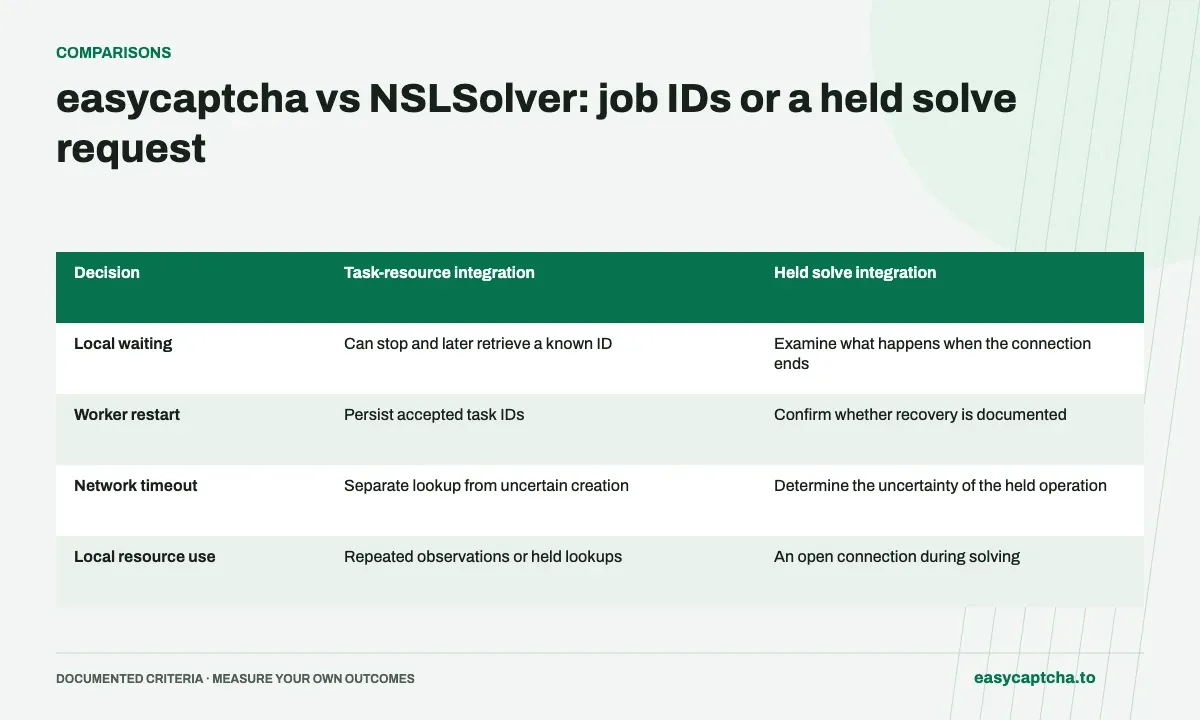
| Decision | Task-resource integration | Held solve integration |
|---|---|---|
| Local waiting | Can stop and later retrieve a known ID | Examine what happens when the connection ends |
| Worker restart | Persist accepted task IDs | Confirm whether recovery is documented |
| Network timeout | Separate lookup from uncertain creation | Determine the uncertainty of the held operation |
| Local resource use | Repeated observations or held lookups | An open connection during solving |
Follow each vendor’s documented error policy. Do not invent a resumption endpoint for a single-call API or assume a closed connection means no server work happened.
Preserve the actual result family
NSLSolver documents results that can be tokens, cookies, or headers depending on the operation. easycaptcha distinguishes hCaptcha recognition from token results. Keep those families explicit in your adapter so a general “solution string” does not conceal incompatible data.
Confirm the current supported provider and required network context before evaluating costs. A task catalog should be checked separately from an API shape.
Measure the whole interaction
Record how much time was spent waiting locally, what result was observed, and whether the application’s intended action completed. Report unknown outcomes rather than converting a disconnected request into a confirmed failure.
This comparison is authored by the easycaptcha team from the primary reference. Polling versus long polling and task recovery describe the corresponding decisions in easycaptcha’s job-ID workflow.
Frequently asked questions
What should I inspect when comparing public solver workflows?
Inspect required inputs, authentication, task states, result retrieval, and error handling. Those details determine the work needed in your adapter.
How can I trial easycaptcha before migrating?
Create a small integration with its documented task API and measure observed acceptance, final outcomes, and cost on representative requests.
How can I evaluate easycaptcha on my own workload?
Start with a small integration trial using representative hCaptcha tasks. Compare observed acceptance, final outcomes, and costs in the actual billing unit rather than relying on a feature table alone.