Solver comparison
easycaptcha vs NoCaptchaAI: recognition and async task boundaries
Compare structured hCaptcha recognition with NoCaptchaAI synchronous solving and its documented async API, including status and input differences.
By the easycaptcha team · Published
NoCaptchaAI documents a synchronous /solve endpoint that takes image and question data, as well as an asynchronous task API. Its solve reference explains the synchronous contract; its documentation index describes the broader API.
Endpoint families
easycaptcha uses typed task creation and retrieval for recognition and tokens. Comparing a synchronous recognition response to an asynchronous token operation without identifying the product can produce misleading conclusions about price and latency.
Preserve input structure
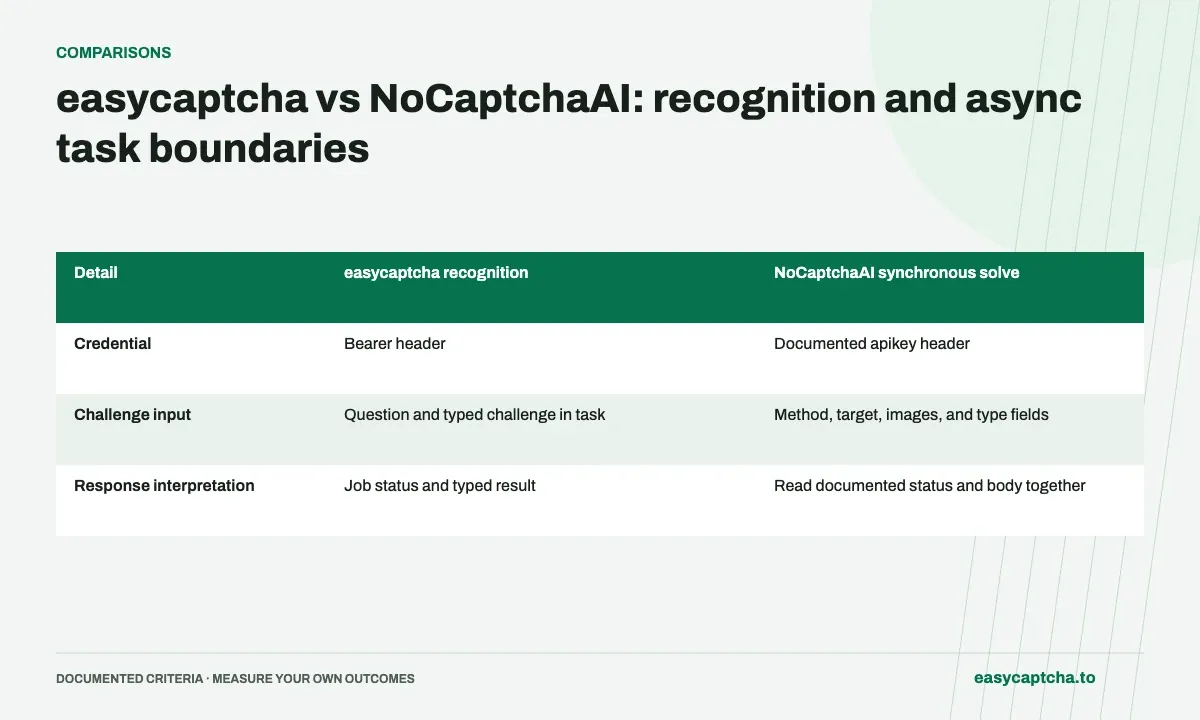
| Detail | easycaptcha recognition | NoCaptchaAI synchronous solve |
|---|---|---|
| Credential | Bearer header | Documented apikey header |
| Challenge input | Question and typed challenge in task |
Method, target, images, and type fields |
| Response interpretation | Job status and typed result | Read documented status and body together |
The linked NoCaptchaAI reference distinguishes its successful solving status from other response cases. Use that exact contract in an adapter rather than treating every valid JSON body as a correct answer.
Evaluate recognition at the application boundary
Retain image identifiers, question data, and any coordinate or entity mapping. Changing input shape can introduce an application bug even when both services understand the image. Check that the same challenge context reaches each service and that returned answers are applied consistently.
For token work, verify current task coverage independently. A recognition endpoint supporting a provider does not establish that a token endpoint supports the same provider or enterprise variant.
Keep observations comparable
Report solver completion, actual acceptance, and final action completion separately. Include unknown outcomes and use the actual billing unit. This article is written by the easycaptcha team and does not claim a measured advantage.
See binary recognition for stable task keys, recognition versus tokens for operation selection, and task recovery for accepted work interrupted by a timeout.
Frequently asked questions
Why choose an endpoint family before comparing solver services?
Recognition and token endpoints can supply different outputs and require different inputs. Compare the operation your application will actually consume.
How should I evaluate easycaptcha against noCaptcha AI?
Use representative tasks with consistent acceptance observations and cost units. Keep API-contract differences visible in the trial.
How can I evaluate easycaptcha on my own workload?
Start with a small integration trial using representative hCaptcha tasks. Compare observed acceptance, final outcomes, and costs in the actual billing unit rather than relying on a feature table alone.