Solver comparison
easycaptcha vs CapMonster Cloud: result polling and task scope
Compare task-resource lookups with CapMonster Cloud result polling, accounting for documented lookup limits and provider-specific request types.
By the easycaptcha team · Published
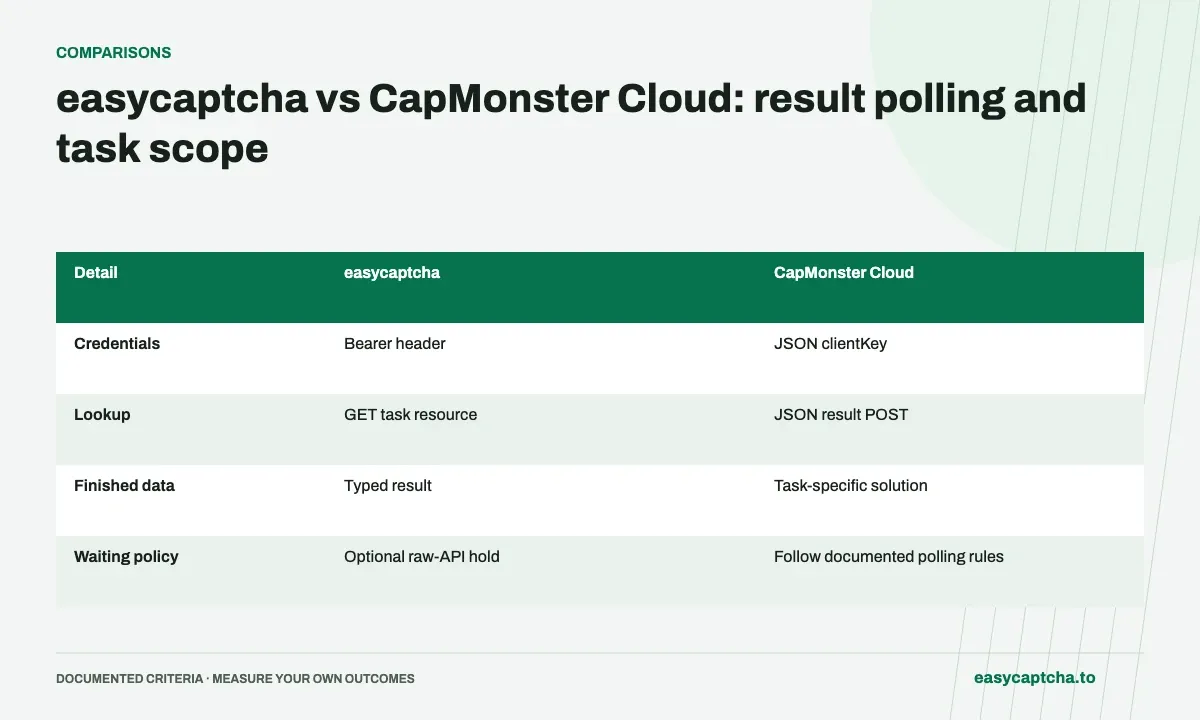
CapMonster Cloud documents JSON createTask and getTaskResult calls. Its result reference uses processing and ready states with task-specific solution data. easycaptcha uses GET retrieval of a task resource and queued, running, completed, or failed snapshots.
Retrieving results
| Detail | easycaptcha | CapMonster Cloud |
|---|---|---|
| Credentials | Bearer header | JSON clientKey |
| Lookup | GET task resource | JSON result POST |
| Finished data | Typed result |
Task-specific solution |
| Waiting policy | Optional raw-API hold | Follow documented polling rules |
See CapMonster’s creation reference for the accepted input contract rather than adapting this table into a request body.
Budget lookup traffic as well as jobs
The CapMonster result documentation states a per-task request limit. A polling interval copied from another service can exhaust such a limit without making the solver finish sooner. Verify the current rule and stop observing terminal jobs.
For easycaptcha, a raw GET can use a held lookup, while basic SDK lookup methods make one observation. Choose a policy suited to the API rather than treating every backend as an identical loop.
Validate the operation and the billed unit
An API’s general task catalog is not evidence that the exact hCaptcha configuration you need is supported today. Confirm coverage and account access directly. Recognition, token, and browser-cookie operations should remain separate in your adapter and cost report.
This comparison is written by the easycaptcha team, not an independent benchmark. Evaluate acceptance and final application completion on the same intended actions. Keep uncertain creation responses visible, and use task recovery to avoid creating replacement work merely because one lookup was slow.
Frequently asked questions
What changes when adapting a CapMonster integration to easycaptcha?
Map task creation and result retrieval explicitly, including authentication, pending states, result types, and errors.
Should uncertain result retrieval trigger a new easycaptcha task?
Preserve the task ID and inspect its state first. A lookup uncertainty does not establish that the submitted work was lost.
How can I evaluate easycaptcha on my own workload?
Start with a small integration trial using representative hCaptcha tasks. Compare observed acceptance, final outcomes, and costs in the actual billing unit rather than relying on a feature table alone.