Solver comparison
easycaptcha vs Anti-Captcha: task contracts and coverage checks
Compare customer authentication, task creation, feedback, and provider coverage without assuming historical hCaptcha task names remain supported.
By the easycaptcha team · Published
Anti-Captcha’s documentation index lists its supported task families and methods. That index is a better starting point than an old client example. easycaptcha’s public API focuses on hCaptcha recognition and token requests, with separate approval for enterprise tokens.
Task coverage
Do not infer hCaptcha availability from the general phrase CAPTCHA solving. Confirm the exact supported operation, expected input, and account permissions before planning a migration. An absent item in a reviewed index is a reason to ask for confirmation, not proof that an undocumented feature can never exist.
Translate credentials and lifecycle
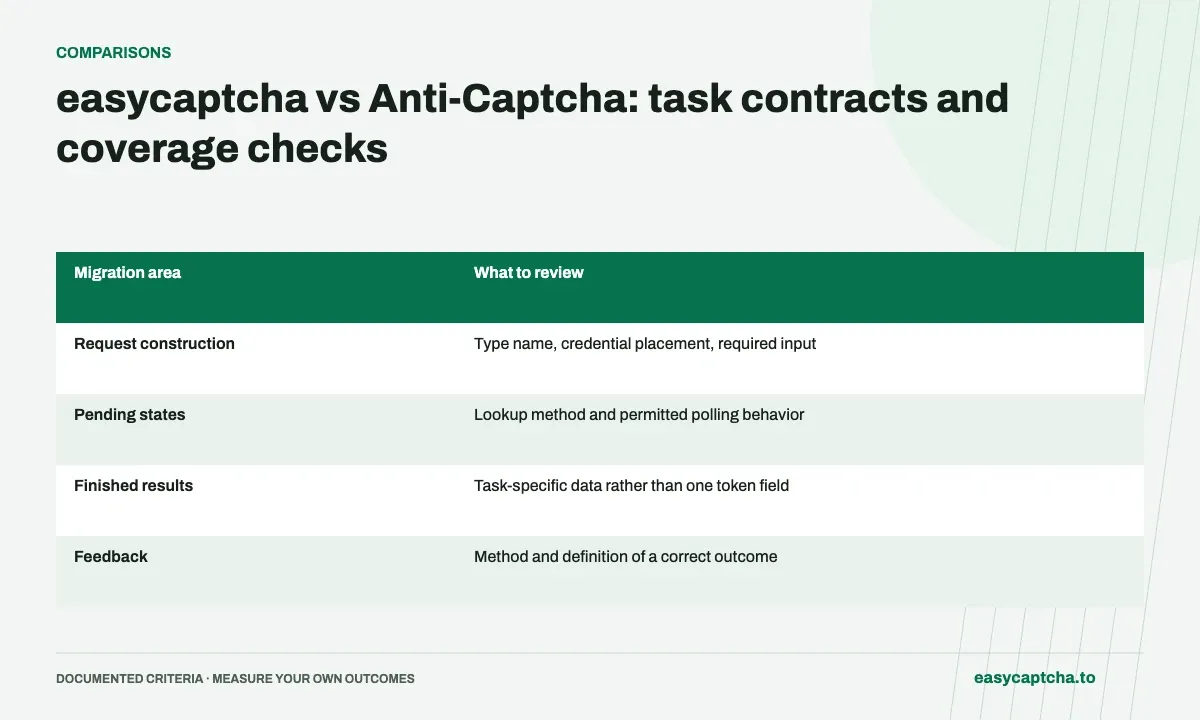
Anti-Captcha documents task creation with a JSON clientKey and task object. easycaptcha sends the customer credential in a Bearer header and creates a typed /v1/task resource. Preserve the task ID, but do not assume identifier types or response fields match.
| Migration area | What to review |
|---|---|
| Request construction | Type name, credential placement, required input |
| Pending states | Lookup method and permitted polling behavior |
| Finished results | Task-specific data rather than one token field |
| Feedback | Method and definition of a correct outcome |
Do not migrate only the happy path
A wrapper that translates creation and ignores errors can turn a clear permission failure into repeated submissions. Map HTTP errors, embedded job failures, and transport uncertainty separately. Retain the operation stage in your diagnostics with credentials redacted.
Compare the cost of the actual task and mode. A language SDK or broad catalog is not a performance result on your sitekey. Run a small evaluation with observed application outcomes and publish unknown observations too.
This page is authored by the easycaptcha team from linked documentation. Read feedback integration for the easycaptcha outcome boundary and the API reference for full wire models.
Frequently asked questions
What should I check before moving from Anti-Captcha to easycaptcha?
Confirm the exact operation supported by each service, then map credentials, task inputs, states, results, and error handling.
Does a provider's general task catalog guarantee my hCaptcha workload is supported?
No. Confirm the current operation and account permissions directly. A broad CAPTCHA-solving description is not an exact integration contract.
How can I evaluate easycaptcha on my own workload?
Start with a small integration trial using representative hCaptcha tasks. Compare observed acceptance, final outcomes, and costs in the actual billing unit rather than relying on a feature table alone.