Solver comparison
easycaptcha vs 2Captcha: API and workflow comparison
Compare easycaptcha task endpoints with 2Captcha API v2. Understand authentication, polling, result states, coverage checks, and migration work.
By the easycaptcha team · Published
Switching CAPTCHA providers touches code that often sits inside a larger browser or application workflow. A familiar task name can make the change look straightforward, while differences in authentication and result handling create most of the practical work. This comparison looks at those boundaries for easycaptcha and 2Captcha.
Authentication and requests
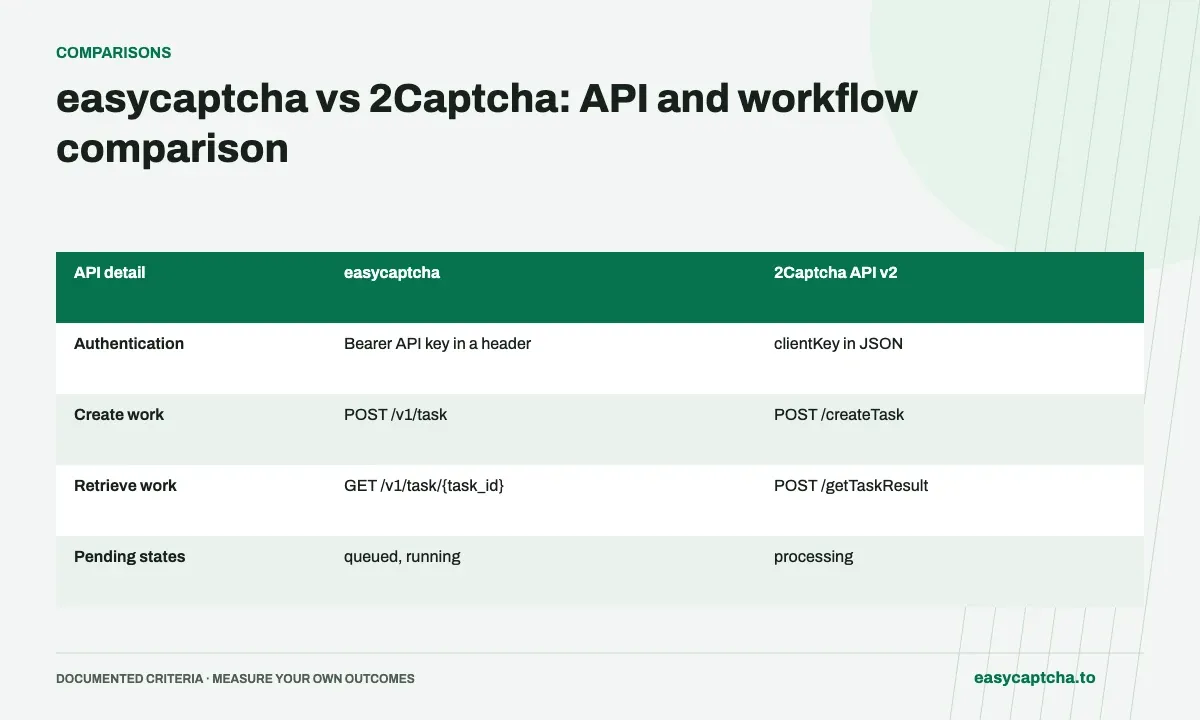
A migration between solving services involves more than changing a base URL. Authentication, task types, status names, results, and feedback can all differ. 2Captcha documents a JSON createTask call followed by getTaskResult; easycaptcha uses a task resource with creation and retrieval endpoints. See the official 2Captcha creation documentation and result documentation.
This article is written by the easycaptcha team. It compares API integration details and proposes an evaluation process. It does not claim that either service is faster or more accurate.
Map the lifecycle explicitly
| API detail | easycaptcha | 2Captcha API v2 |
|---|---|---|
| Authentication | Bearer API key in a header | clientKey in JSON |
| Create work | POST /v1/task |
POST /createTask |
| Retrieve work | GET /v1/task/{task_id} |
POST /getTaskResult |
| Pending states | queued, running |
processing |
| Completion | completed, typed result |
ready, task-specific solution |
| Failure handling | HTTP Problem Details or embedded task error | Documented error fields |
The 2Captcha fields come from its API v2 documentation. Treat this as a lifecycle map, not a drop-in task translation. Confirm the task type and result contract separately for every operation you use.
Verify provider coverage directly
Do not assume that a service’s general CAPTCHA catalog guarantees the task you need is available for your account or site configuration. Check the current provider documentation and request an evaluation if the required type is unclear.
easycaptcha’s customer API currently focuses on hCaptcha recognition, regular hCaptcha tokens, and approved enterprise token tasks. It does not offer a general token task for every CAPTCHA provider. Review the API reference before moving a workload that uses several providers.
Review retries and credentials
Keep each service’s credentials separate. A JSON field used by one vendor is not automatically the right place for another vendor’s key. Avoid logging whole request bodies if they contain credentials, and update redaction when changing clients.
Persist the new task ID after creation. A timed-out creation request has an uncertain outcome; silently creating replacement jobs can duplicate paid work. Lookups are different from submissions, and your retry policy should express that distinction. Update status handling and terminal errors together rather than adapting only the successful response.
Compare cost and outcomes on the same workload
Use the current vendor price for the actual task unit, including any account conditions or premium mode. The easycaptcha pricing page separates recognition groups from token tasks. A workload billed per group cannot be compared to a different task unit by dividing both balances by a guessed common price.
For a migration trial, record an observed outcome for each attempted application action, plus latency and charge information. State what remains unknown and keep failure stages separate. Our success-rate guide explains the reporting model; the JavaScript SDK guide shows the easycaptcha job lifecycle.
Frequently asked questions
Can I reuse a 2Captcha request unchanged with easycaptcha?
Treat the services as separate API contracts. Adapt authentication, task creation, lookup, results, and errors rather than changing only the hostname.
How should I compare easycaptcha and 2Captcha performance?
Test a representative workload with consistent acceptance and cost definitions. This API comparison does not establish that either service is faster or more accurate.
How can I evaluate easycaptcha on my own workload?
Start with a small integration trial using representative hCaptcha tasks. Compare observed acceptance, final outcomes, and costs in the actual billing unit rather than relying on a feature table alone.