Latency analysis
Why CAPTCHA tail latency matters more than one average
Report slow completion, deadlines, observation coverage, and recovery alongside median behavior so rare waits are not hidden by a favorable mean.
By the easycaptcha team · Published
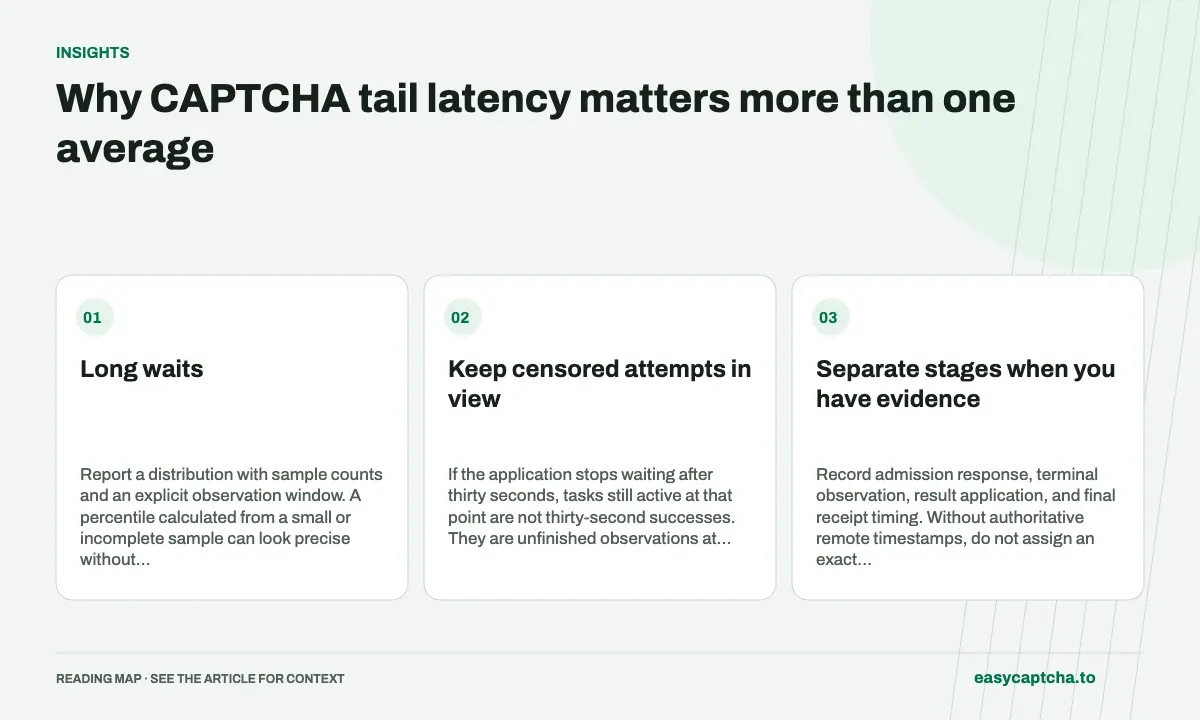
A service can complete many tasks quickly while a smaller group waits much longer. An average may obscure those attempts, particularly when the user-facing workflow loses state or reaches a deadline during the wait.
Long waits
Report a distribution with sample counts and an explicit observation window. A percentile calculated from a small or incomplete sample can look precise without establishing a stable expectation.
Keep censored attempts in view
If the application stops waiting after thirty seconds, tasks still active at that point are not thirty-second successes. They are unfinished observations at the cutoff. Reconcile known IDs later where possible and show how many attempts remain unknown.
A shorter timeout can make an average look better by removing slow completions. That is a change in observation, not evidence of faster remote work.
Separate stages when you have evidence
Record admission response, terminal observation, result application, and final receipt timing. Without authoritative remote timestamps, do not assign an exact internal solve duration to the entire client interval.
A long wait can originate in a local queue, network, remote waiting, or the observer’s lookup pause. The proposed fix should target the stage supported by evidence.
Evaluate recovery as part of latency
A person who can safely leave a task and resume a known result has a different experience from someone whose form disappears while waiting. Track preserved drafts, clear cancellation of local waiting, and known acceptance after interruption.
Do not repeat paid creation merely to shorten a visible spinner. A second task can add cost while leaving the first uncertain.
Present a bounded conclusion
State the cohort, what timestamps were observed, and what slow or unknown cases remained. Avoid turning a favorable median into a completion-time guarantee.
Timing stages explains event pairs, unknown outcomes preserves missing evidence, and long-form recovery connects the statistical tail to the visitor’s actual ability to finish the task.
Frequently asked questions
Why look beyond average solve time?
An average can hide the long waits that affect retries, abandonment, and time-sensitive actions. Examine the distribution relevant to your workflow.
Does fast mode eliminate every long wait?
No guarantee follows from queue priority alone. Compare actual outcomes and waiting-time distributions for the modes and workload you use.
How can I evaluate easycaptcha on my own workload?
Start with a small integration trial using representative hCaptcha tasks. Compare observed acceptance, final outcomes, and costs in the actual billing unit rather than relying on a feature table alone.