Challenge analysis
Sitekey segmentation without assuming identical challenges
Use public configuration attribution to separate flows while keeping task families, variants, and unknown outcomes visible within each group.
By the easycaptcha team · Published
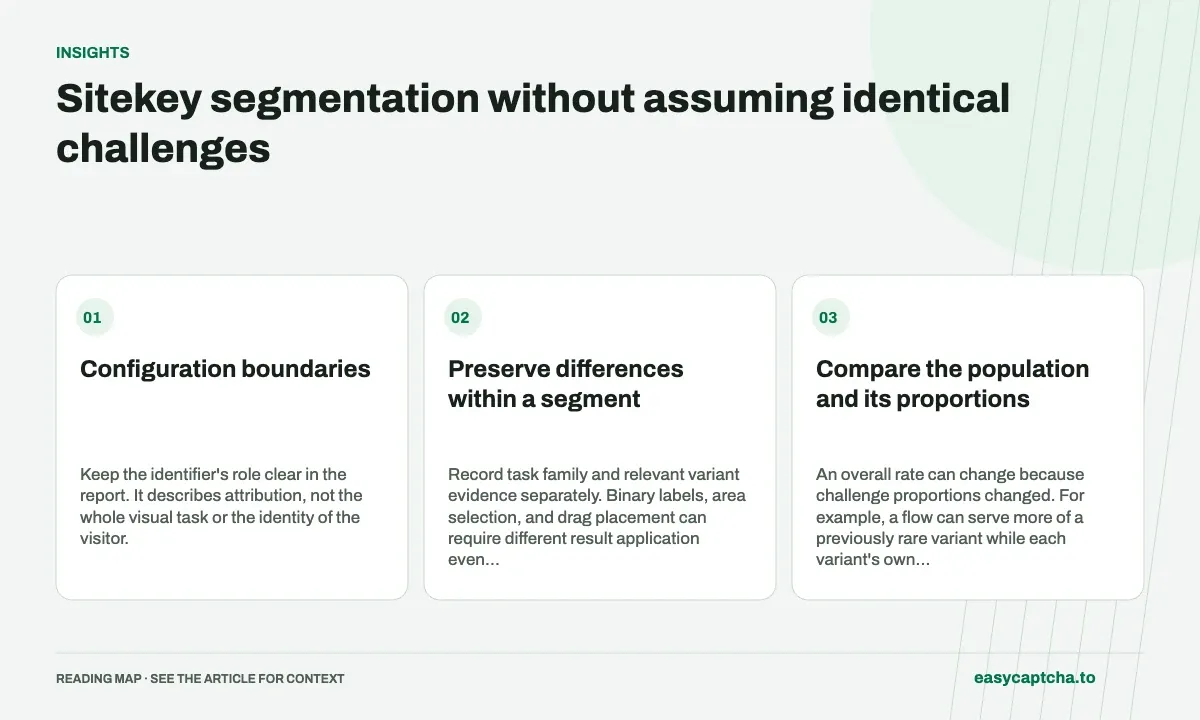
A sitekey can identify a configured flow and help separate measurements for login, registration, or another application operation. In easycaptcha recognition requests, the optional sitekey attributes challenge statistics to the originating site. It does not turn recognition into token solving or establish that every challenge under that key is identical.
Configuration boundaries
Keep the identifier’s role clear in the report. It describes attribution, not the whole visual task or the identity of the visitor.
Preserve differences within a segment
Record task family and relevant variant evidence separately. Binary labels, area selection, and drag placement can require different result application even when the same configured flow serves them. Question wording can also remain stable while visual relationships change.
A segment with a favorable aggregate rate can contain a small, difficult subgroup. Review sample counts and outcomes within the meaningful strata rather than assuming the overall value applies equally to all work.
Compare the population and its proportions
An overall rate can change because challenge proportions changed. For example, a flow can serve more of a previously rare variant while each variant’s own performance stays similar. That is a population shift, not by itself a model regression.
Retain grouping rules and their versions. An analysis that reclassifies old data without recording the taxonomy can make historic reports impossible to reproduce.
Keep acceptance and coverage explicit
Observe solver completion, verification acceptance, and the final application action separately. Unknown outcomes belong in each segment instead of disappearing from the calculation. A public configuration label does not resolve an interrupted submission.
Keep attribution records limited to the analysis purpose. Do not add account keys, proof values, or full form bodies simply because the event already contains a sitekey.
The sitekey guide explains credential distinctions. Variant drift separates wording from visual work, and cohort design makes the comparison population reviewable before a single aggregate percentage becomes a claim about an entire flow.
Frequently asked questions
Why group recognition results by sitekey?
A sitekey is a useful configuration boundary for comparing workload and outcomes. Keep other relevant cohort differences visible as well.
Does sitekey attribution turn recognition into token solving?
No. It attributes a recognition request to a configuration. The task type and returned result still determine the operation.
How can easycaptcha fit into my integration tests?
Use the documented recognition or token API for the hCaptcha stage, preserve task IDs, and inspect terminal results. Measure verifier acceptance and application completion separately from job completion.