Cost analysis
Measuring CAPTCHA cost per accepted outcome
Account for all admitted work, unknown results, mode multipliers, and adjustments when calculating the cost of a completed application action.
By the easycaptcha team · Published
The price of a single CAPTCHA request is only part of what an integration costs. Retries, incomplete work, and results that never lead to a completed action all affect the amount spent on a useful outcome. Looking at those outcomes gives teams a better basis for budgeting and comparison.
Choosing a denominator
Cost per created task, cost per returned result, cost per accepted proof, and cost per completed action answer different questions. Choose the one relevant to the decision and name it explicitly. A low cost per generated token can coexist with an expensive final workflow if acceptance is poor or repeated work is hidden.
Keep a correlation between the intended operation and all the solving work it caused. A fallback or retry creates another cost event even if the application eventually shows one successful completion.
Use an illustrative calculation carefully
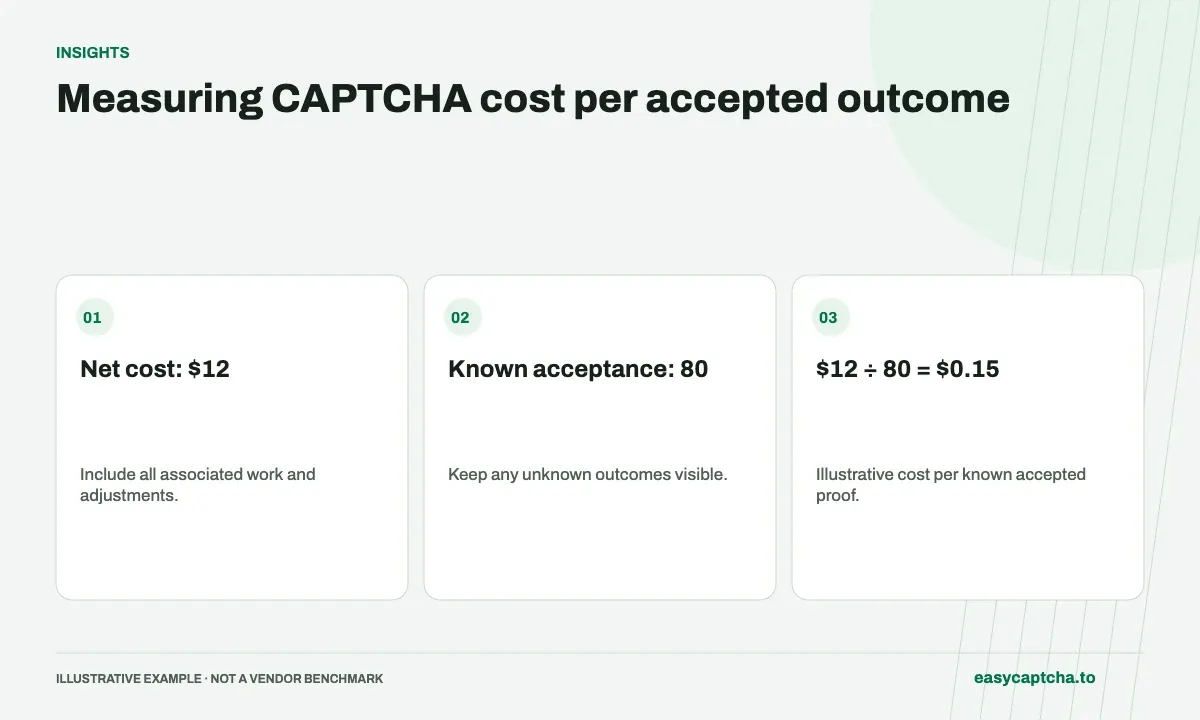
Suppose a controlled cohort incurs $12 of net solving cost and produces 80 known accepted proofs. Cost per known accepted proof is $12/80, or $0.15. If twenty outcomes remain unknown, do not describe the same calculation as the cost per outcome for a fully observed hundred-attempt population.
The figures are an example, not easycaptcha pricing or a measured vendor result. Your real report needs actual charges, group counts, account rates, selected modes, and adjustments.
Preserve the pricing unit
Recognition is billed per group, while token work has its own rate. A browser interaction containing several image groups can generate several billed recognitions. Burst and fast can apply additional multipliers.
Use integer microcents for accounting and the documented rounding boundaries. Convert to decimal dollars for display after the underlying arithmetic is complete. A balance read is a snapshot, not a reservation or a complete charge ledger.
Reconcile late results and reversals
A local timeout does not establish no cost occurred. Retain accepted IDs and unresolved creation events. Keep the reporting cutoff and later reconciliation visible when delayed information changes the cohort’s observed total.
Do not omit a refunded or reversed event simply because it complicates a local estimate. Show net spend and, when useful, the gross activity that produced it.
Pricing-unit comparison separates products, unknown outcomes keeps missing evidence visible, and budget integration documents the exact monetary unit for calculations instead of rounded display values.
Frequently asked questions
How do I calculate cost per accepted challenge?
Divide the associated net cost by the number of observed accepted outcomes. Include relevant retries and keep unknown outcomes visible.
Is a lower request price always cheaper overall?
No. Different billing units, retries, and acceptance rates can change the cost of a useful result. Compare representative workflows.
How can I evaluate easycaptcha on my own workload?
Start with a small integration trial using representative hCaptcha tasks. Compare observed acceptance, final outcomes, and costs in the actual billing unit rather than relying on a feature table alone.