Challenge analysis
Grouping CAPTCHA questions without erasing important differences
Normalize incidental text variation carefully and preserve a path for meaningful instructions, languages, and visual variants to remain distinguishable.
By the easycaptcha team · Published
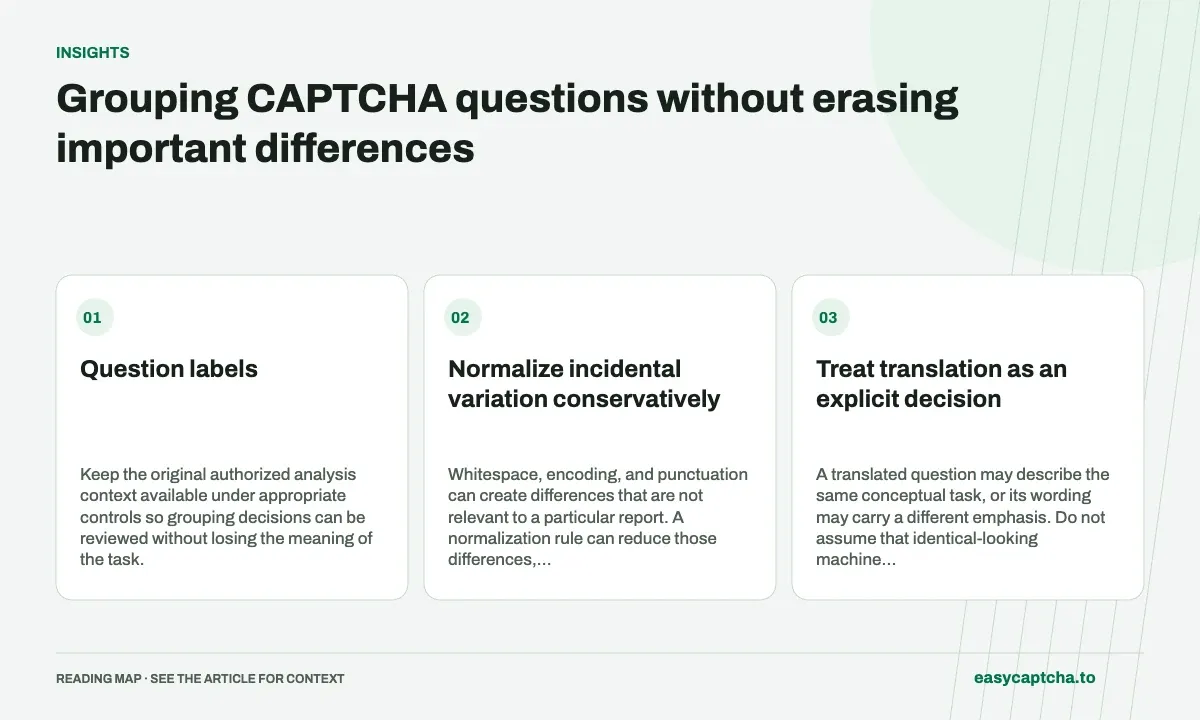
Text grouping can help report related instructions, but it is not a complete identity for an individual challenge. Decide whether the label is intended to group spelling variants, translated instructions, semantic tasks, or model-relevant visual families. One hash cannot safely stand for all of those decisions.
Question labels
Keep the original authorized analysis context available under appropriate controls so grouping decisions can be reviewed without losing the meaning of the task.
Normalize incidental variation conservatively
Whitespace, encoding, and punctuation can create differences that are not relevant to a particular report. A normalization rule can reduce those differences, but it should be versioned and tested against examples where a small wording change does matter.
Negation, quantities, target relationships, and requested actions can change the task. Removing them to make more strings match can merge opposite instructions into the same group.
Treat translation as an explicit decision
A translated question may describe the same conceptual task, or its wording may carry a different emphasis. Do not assume that identical-looking machine embeddings prove equivalence. Review representative examples and keep uncertain cases separate.
The request family also matters. A similar instruction applied to binary selection and drag placement produces different output models and application responsibilities.
Preserve visual variants
The same normalized instruction can appear with different visual reasoning requirements. Report a text group and a meaningful variant separately where evidence supports it. An image-byte hash distinguishes encodings as well as content and should not be confused with a semantic family.
This article proposes analysis choices rather than documenting a shipped fingerprinting feature. Variant drift explains population changes, cohort design controls comparison, and recognition families keeps task-type differences visible when grouping otherwise similar text.
Frequently asked questions
Why normalize challenge questions for analysis?
Consistent labels can group related wording for analysis. Keep the original question so that grouping does not erase meaningful differences.
Should I send a rewritten question to the recognition API?
Preserve the original challenge instruction in the request. Use separate analytical labels rather than replacing the question the model needs to solve.
How can easycaptcha fit into my integration tests?
Use the documented recognition or token API for the hCaptcha stage, preserve task IDs, and inspect terminal results. Measure verifier acceptance and application completion separately from job completion.