Network comparison
Proxy vs proxyless tasks: compare the network contract
Understand who supplies worker networking, why vendor proxyless labels differ, and how local API transport proxies remain a separate configuration.
By the easycaptcha team · Published
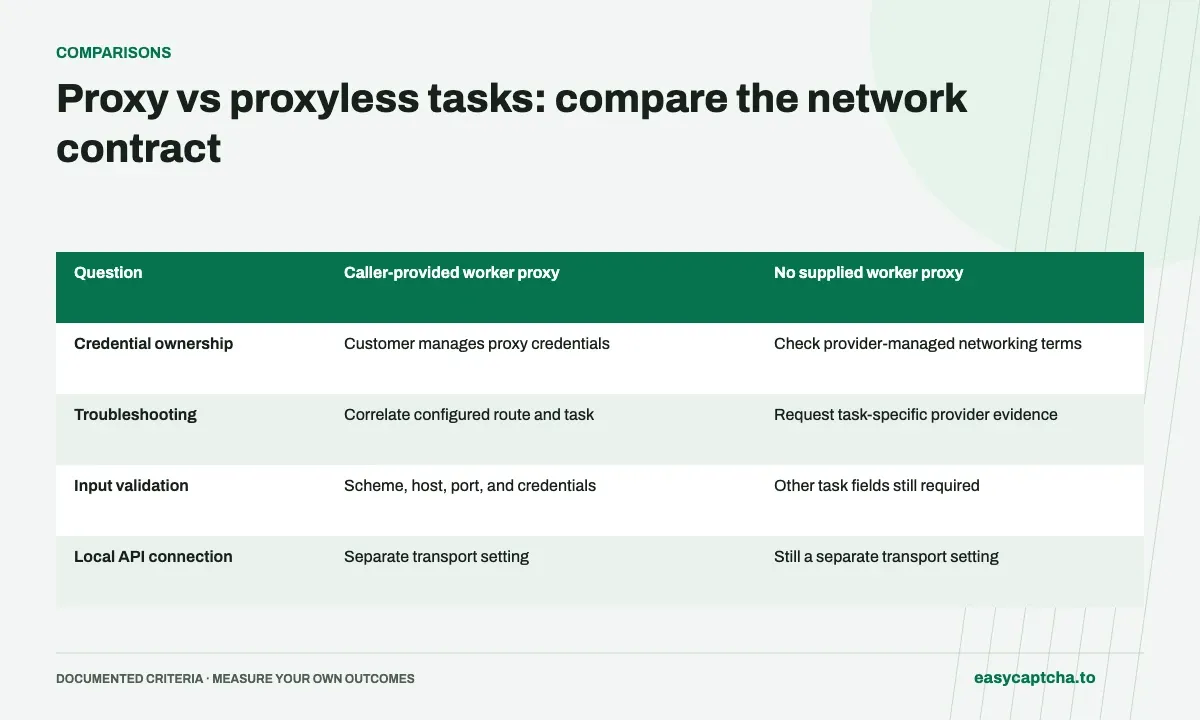
A proxy option may control your application’s connection to a solver or the worker’s connection to a challenge. Those are separate network paths. A proxyless label usually refers to a task contract in which the caller does not provide a worker proxy, but exact behavior must come from that vendor’s task reference.
Network paths
Do not infer a universal network guarantee from the label. Different task families can require different context and return different artifacts.
Compare the responsibilities
| Question | Caller-provided worker proxy | No supplied worker proxy |
|---|---|---|
| Credential ownership | Customer manages proxy credentials | Check provider-managed networking terms |
| Troubleshooting | Correlate configured route and task | Request task-specific provider evidence |
| Input validation | Scheme, host, port, and credentials | Other task fields still required |
| Local API connection | Separate transport setting | Still a separate transport setting |
In easycaptcha, token requests accept the documented structured proxy object. The optional field does not replace the customer API key, sitekey, or URL.
Keep uncertainty tied to the stage
If the application cannot reach the API, task creation may remain uncertain. If a worker has accepted the task and then encounters a network problem, an ID already exists. Preserve that distinction in recovery records instead of retrying every case through another route.
Changing a proxy also changes an evaluation condition. Record a non-secret configuration identifier so shifts in acceptance are not automatically attributed to the solver. Never log proxy passwords alongside challenge input.
Choose using the intended workflow
Verify provider coverage, required context, and the resulting artifact before deciding whether supplying networking is useful. A cookie-based workflow and a token workflow should not be treated as equivalent merely because both have a proxy field.
Read worker proxy configuration for easycaptcha input and network-context evaluation for controlled comparisons. The curl_cffi guide explains why a local transport choice does not populate worker networking automatically.
Frequently asked questions
What does proxyless describe in a token task?
It describes the connection arrangement for that task. It does not establish that every part of the application shares the same network context.
How do I configure a proxy for an easycaptcha token job?
Use the documented proxy object and supported fields. Evaluate the resulting verification outcome in the workflow that consumes the token.
How do I start using the easycaptcha API?
Create an account and get an API key, then follow the getting-started guide. Submit recognition or token tasks through raw HTTP or the typed Python and JavaScript SDKs.