Mode comparison
Burst vs fast: concurrency and priority are different
Compare easycaptcha burst admission with fast queue priority, including account weights, price multipliers, and the limits of each mode.
By the easycaptcha team · Published
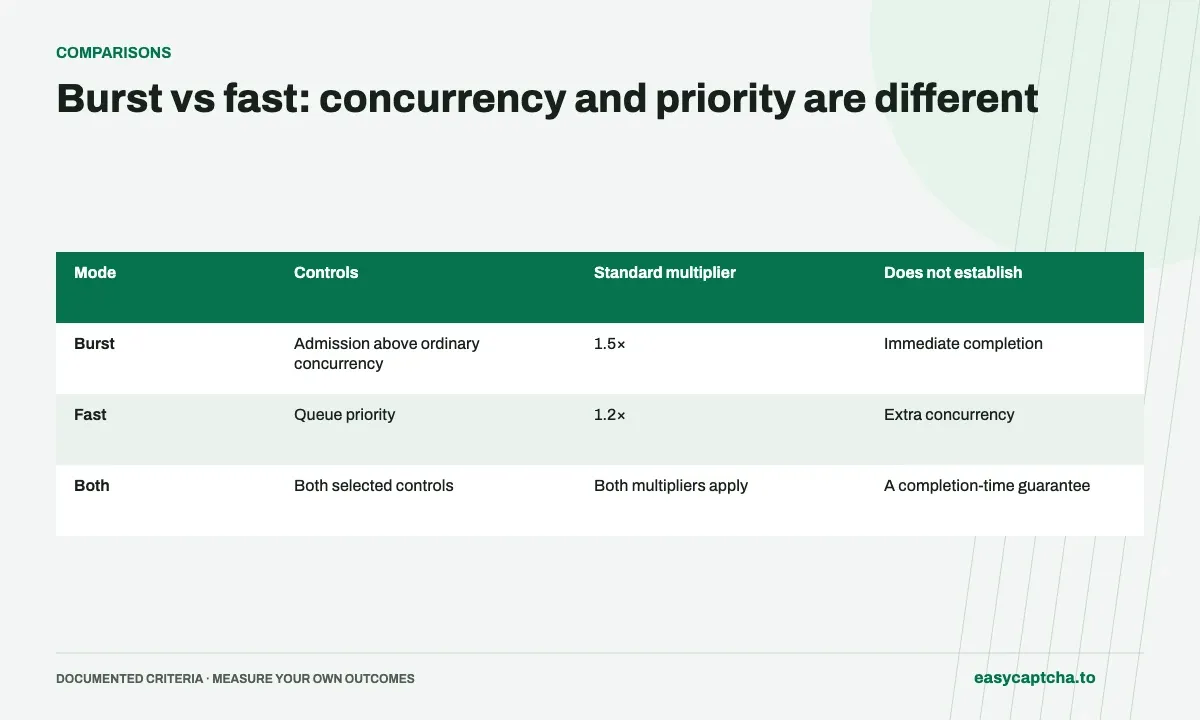
Burst permits paid tasks above normal weighted concurrency within a defined ceiling. Fast raises a task’s queue priority. If a request is rejected because active weighted work exceeds the ordinary limit, priority alone does not solve admission. If a task was admitted but is waiting, extra admission capacity does not itself make a worker choose it sooner.
Capacity and latency
Use the mode related to the problem you observed, and keep the rest of the lifecycle unchanged.
Compare controls and prices
| Mode | Controls | Standard multiplier | Does not establish |
|---|---|---|---|
| Burst | Admission above ordinary concurrency | 1.5× | Immediate completion |
| Fast | Queue priority | 1.2× | Extra concurrency |
| Both | Both selected controls | Both multipliers apply | A completion-time guarantee |
The mode contract also describes custom rates and the burst ceiling. Recognition counts one concurrency unit; token work counts ten. Limits span the account’s keys.
Avoid accidental permanent premiums
A task marked burst uses the mode price even if it fits below ordinary capacity. A helper that always sets both booleans can therefore change billing across a quiet workload without a clear need.
Make defaults explicit and record chosen modes in evaluation data. Use exact microcent arithmetic with the documented rounding rule, including recognition group count. Do not estimate every task as one base-priced event.
Measure the stage a mode can affect
Separate admission, queue waiting, solver work, and local observation. A shorter polling interval can improve observed latency without improving queue time. A local queue can smooth spikes without requiring extra remote admission.
See mode integration for request fields, bounded scheduling for local control, and timing analysis for a report that distinguishes changes to waiting from changes to solving.
Frequently asked questions
What is the difference between easycaptcha burst and fast modes?
Burst increases the admission capacity available under the account's documented limit. Fast gives higher queue priority. They address different constraints.
Do burst and fast modes cost extra?
Yes. Burst uses a 1.5 times multiplier and fast uses a 1.2 times multiplier. Check the pricing and mode documentation for your request.
How do I start using the easycaptcha API?
Create an account and get an API key, then follow the getting-started guide. Submit recognition or token tasks through raw HTTP or the typed Python and JavaScript SDKs.