Integration fundamentals
Enterprise CAPTCHA terminology for integrations
Distinguish enterprise provider features, enterprise task types, account access, and flow-specific data without assuming every vendor uses the term identically.
By the easycaptcha team · Published
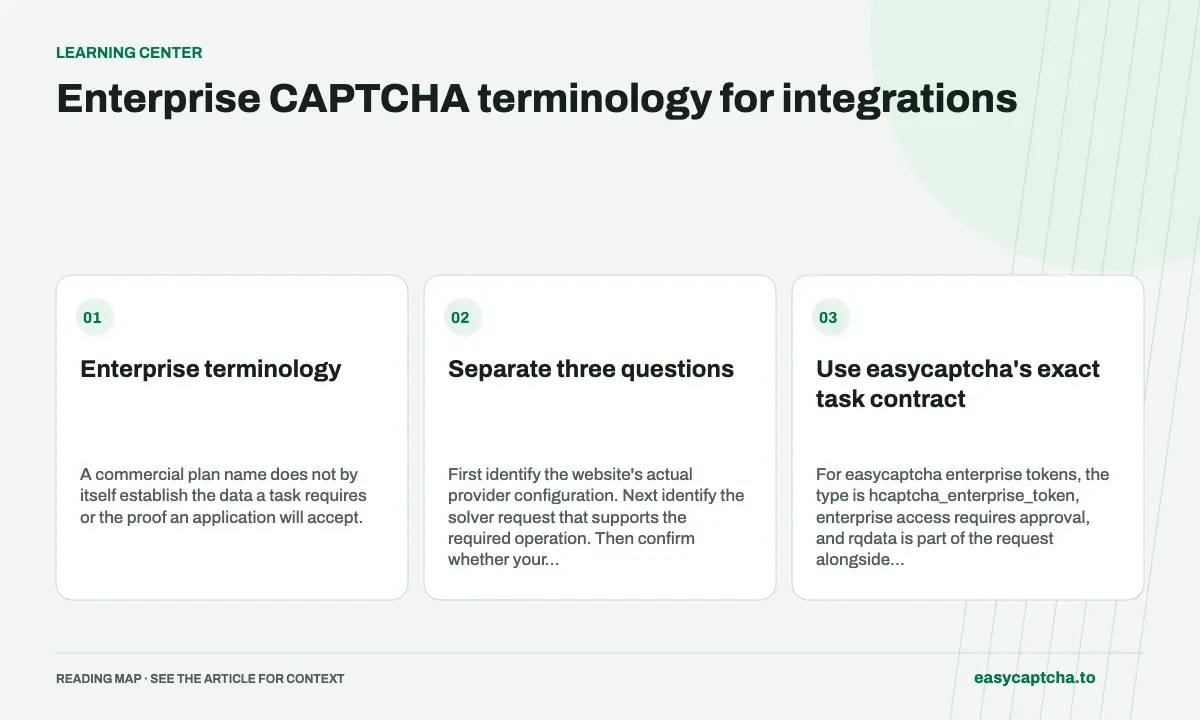
A provider may use enterprise to name a product tier, a verification mode, an account feature, or a task family. A solver can use a related term for the request it supports. Those meanings should be mapped explicitly before an integration treats them as equivalent.
Enterprise terminology
A commercial plan name does not by itself establish the data a task requires or the proof an application will accept.
Separate three questions
First identify the website’s actual provider configuration. Next identify the solver request that supports the required operation. Then confirm whether your customer account is permitted to submit it. Each can be correct while another is wrong.
| Question | Relevant evidence |
|---|---|
| What does the site use? | Its configured public key and flow |
| What does the solver accept? | Current task-specific API schema |
| Can this account submit it? | Current service entitlement |
Do not solve an entitlement failure by guessing another type name. Do not solve a missing-input error by replacing a real public key with an account credential.
Use easycaptcha’s exact task contract
For easycaptcha enterprise tokens, the type is hcaptcha_enterprise_token, enterprise access requires approval, and rqdata is part of the request alongside sitekey and URL. Regular tokens use a different type and rate. The API reference is authoritative for fields and bounds.
The response lifecycle remains creation, pending observation, and terminal result handling. Store the ID and keep uncertain creation separate from a definite rejection.
Evaluate the actual enterprise flow
A success on a regular demonstration does not prove the enterprise configuration works. Use representative input and record observed acceptance, timing, and the actual billing unit.
Enterprise setup describes access and request construction. Regular versus enterprise tasks compares easycaptcha’s rules, while context checks shows how verification expectations remain server-owned rather than caller-selected.
Frequently asked questions
Does enterprise mean the same thing for every CAPTCHA provider?
No. Features, credentials, task inputs, and account permissions vary. Use the documentation for the specific provider and operation.
What does an easycaptcha enterprise token request require?
It requires the enterprise hCaptcha task type, sitekey, page URL, and rqdata. The account also needs explicit access to enterprise token tasks.
How do I start using the easycaptcha API?
Create an account and get an API key, then follow the getting-started guide. Submit recognition or token tasks through raw HTTP or the typed Python and JavaScript SDKs.